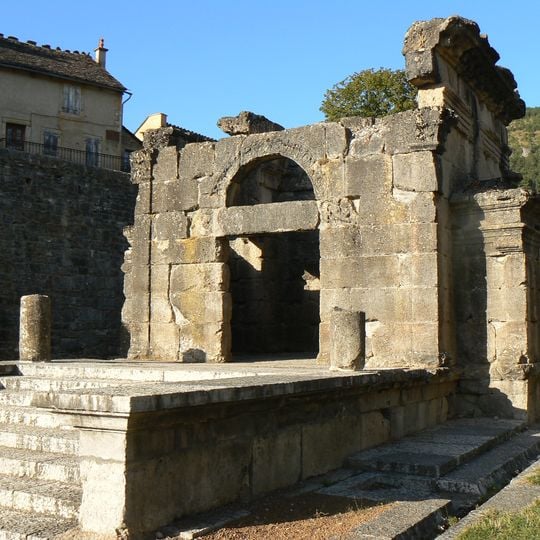
Mausolée de Lanuéjols, Gallo-Roman mausoleum in Lanuéjols, France.
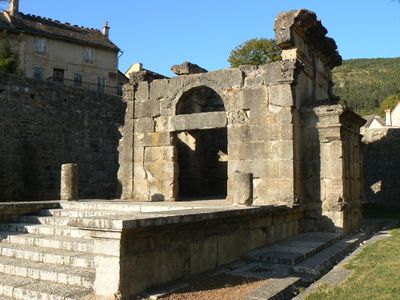
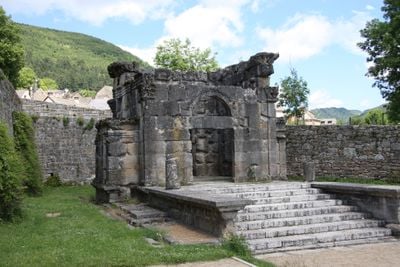
The Mausolée de Lanuéjols is a Gallo-Roman temple-mausoleum of limestone blocks, now partly ruined and open at the top. Its main facade has a tall round-arched opening into a small inner chamber, framed by Corinthian pilasters, and it stands on a podium with a projecting stepped base and a wide flight of shallow stone steps. A jagged broken section of masonry rises at the top right.
Built in the second half of the 2nd century AD as a mausoleum-temple, it was commissioned by Lucius Julius Bassianus and Pomponia Regola for their sons Lucius Pomponius Bassulus and Lucius Pomponius Balbinus. The site was cleared of sediment in 1813 and listed as a monument historique in 1840. The staircase to the pronaos was rebuilt in 1999–2000.
The name "Lou Mazelet", Occitan for "little house", is what locals call the monument. The dedicatory inscription on the cella lintel names the parents Lucius Julius Bassianus and Pomponia Regola, who built and dedicated the temple to their sons Lucius Pomponius Bassulus and Lucius Pomponius Balbinus. A 1254 notarial act attributed the construction to "Saracens".
The site lies at the bottom of the Valdonnez valley, five metres below the surrounding land, beside the Gravière stream; the mausoleum faces north-east to south-west, following the valley. Since 1991, drainage, footpaths and illustrated panels have been installed around the monument, and the stairway to the pronaos was rebuilt in 1999 and 2000.
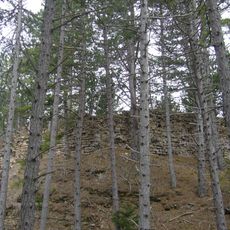
The site's name "Lou Mazelet" comes from Occitan for "little house". The funerary complex also held a third building, probably larger than the mausoleum and possibly the tomb of the parents; its 150 scattered blocks are now lined along a path. Sediment from the Gravière stream buried the monument several times, which likely spared it from weathering and looting.
The community of curious travelers
AroundUs brings together thousands of curated places, local tips, and hidden gems, enriched daily by 94,657 contributors worldwide.