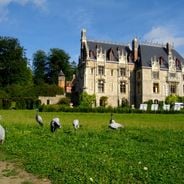
Château d'Auffay, Renaissance manor in Pays de Caux, France.
Château d'Auffay is a manor on the plateau above the wooded slope down to the valley in Oherville, not in the Durdent Valley. Its red-brick walls are laid in alternating courses with sandstone and knapped flint forming diamonds, crosses and bands; two round towers with conical roofs flank the front, a taller square tower rises at the centre, and a dovecote of the same style stands on the estate.
A castle stood here in the 11th–12th centuries; its motte survives beside the house. Guillaume d'Houdetot rebuilt after the English burned his castle at Houdetot in 1423, and work began mid-15th century under his son Jean. Jacques d'Houdetot and his great-nephew Antoine built the present manor in the early 16th century. The château was listed as a monument historique on 2 February 1932.
The manor's walls alternate layers of brick, sandstone and knapped flint with tight joints, a building method of the Pays de Caux. The Houdetot family held the estate until the 17th century; Pierre d'Houdetot remodelled it in Renaissance taste, and the vestibule's coffered vault, dated 1553, is traditionally attributed to Jean Goujon. In 1747 Charles Edward Stuart stayed here with his cousin Louis d'Houdetot.
The manor is a private residence, open only in summer and on European Heritage Days, when the house and its dovecote can be visited. Cultural events such as exhibitions and theatrical performances are held there frequently. Check opening conditions before travelling, as access is not continuous.
The dovecote and the castle motte with its moat were separately listed on 6 September 1996, while the manor itself had been listed since 2 February 1932. The motte is a remnant of an 11th–12th-century castral site that preceded the present building.
The community of curious travelers
AroundUs brings together thousands of curated places, local tips, and hidden gems, enriched daily by 93,847 contributors worldwide.