Basilica of St. Ann of Auray, Renaissance Revival minor basilica in Sainte-Anne-d'Auray, France
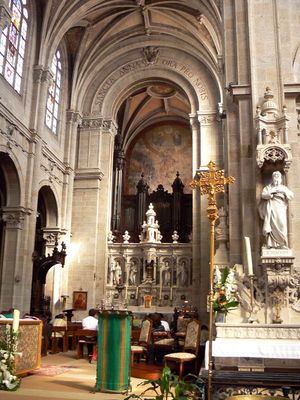
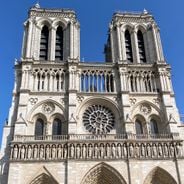
The Basilica of Saint Ann of Auray is a grey ashlar church with two square towers topped by clustered pinnacles and, at the far right, a tall openwork spire pierced with tiers of arched openings and crowned by a small statue. Its central facade holds a large rose window above a recessed arched portal with dark doors. Inside, a stone arch carved with "SANCTA ANNA ORA PRO NOBIS" frames a white stone altarpiece with sculpted figures and a tiered spire, backed by a dark wooden organ; to the right stands a carved monument with a marble statue labelled "S. JOACHIM".
In the night of 7–8 March 1625 a mysterious candle led the peasant Yvon Nicolazic to his field at Bocenno, where an old olive-wood statue was dug up. A first stone was laid on 26 July 1625 and the chapel was solemnly blessed on 4 July 1628 by the official of Vannes. Carmelite friars settled at Ker Anna on 16 February 1628 and built a convent and two-level cloister beside it between 1638 and 1641.
The great pardon of Saint Anne is held here every 26 July, drawing 20,000 to 30,000 pilgrims, the third-largest pilgrimage gathering in France after Lourdes and Lisieux. The sanctuary receives more than 800,000 visitors a year, most of them pilgrims. Breton tradition expresses the pull of the site in Auguste Brizeux's line: "Dead or alive, every Breton must go to Sainte-Anne once."
The sanctuary lies in the village of Sainte-Anne-d'Auray, in the Morbihan department of Brittany. The great pardon of Saint Anne takes place on 26 July and draws 20,000 to 30,000 pilgrims, so the square in front of the basilica fills early that day. The Scala Santa, moved stone by stone in 1870, now stands at the far end of the Champ de l'Épine. The Ker-Anna fountain, rebuilt by the Carmelites in 1898, sits in a stone enclosure.
The basilica houses a thirteenth-century relic believed to be from Saint Anne, originally brought from Jerusalem and donated to the site through the generosity of Queen Anne of Austria and King Louis XIII of France. This precious object remains an important reason why pilgrims visit the location.
The community of curious travelers
AroundUs brings together thousands of curated places, local tips, and hidden gems, enriched daily by 93,848 contributors worldwide.