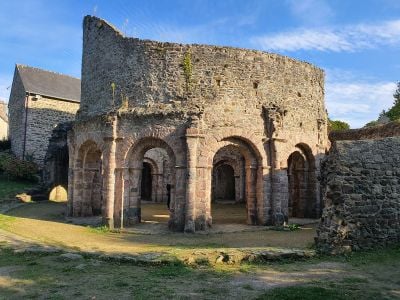
Lanleff temple, Romanesque church in Lanleff, France
Lanleff temple is a circular Romanesque church featuring two concentric rings built from pink sandstone, dark volcanic stones, and gray-beige granite. The structure sits on thick foundation walls and is supported by rounded arches resting on square stone pillars.
Built between 1060 and 1080, this Romanesque rotunda was long mistaken for a Gallo-Roman temple, a Celtic sanctuary or a Templar chapel. Its dating rests on a document of 1148, found in the 19th century, recording the gift of Sainte-Marie-de-Lanlem to the Benedictine abbey of Saint-Magloire in Léhon. Two annexes were added in the 15th and 18th centuries, including the parish church demolished in 1855.
Locals call the building the temple of Lanleff, a name that reflects centuries of uncertainty over its origin: it was taken for a Gallo-Roman temple, a Celtic sanctuary, a Merovingian baptistery and a Templar foundation before its 11th-century date was established. Half-columns on the arcade piers and outer wall carry carved capitals and bases.
The rotunda is roofless and open to the sky, so the earthen floor can be muddy after rain; sturdy shoes help. Only the inner round survives, with the northern half of the outer wall and one apse missing, so the arcade of rounded arches can be walked around on foot. The site lies in the village of Lanleff, in the Côtes-d'Armor department of Brittany.
The round church was long mistaken for a Gallo-Roman temple, a Celtic sanctuary or a Merovingian baptistery before a document found in the 19th century, dated 1148, settled its date: it records the gift of Sainte-Marie-de-Lanlem to the Benedictine abbey of Saint-Magloire in Léhon. Hence the popular name temple de Lanleff, in Breton Templ Lanleñv.
The community of curious travelers
AroundUs brings together thousands of curated places, local tips, and hidden gems, enriched daily by 94,172 contributors worldwide.