Saint Laumer Royal Abbey of Blois, Benedictine abbey in Blois, France
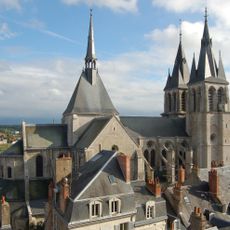
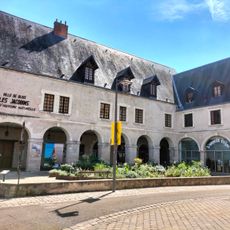
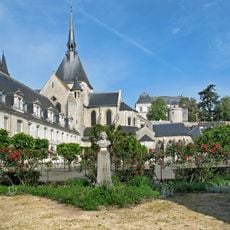
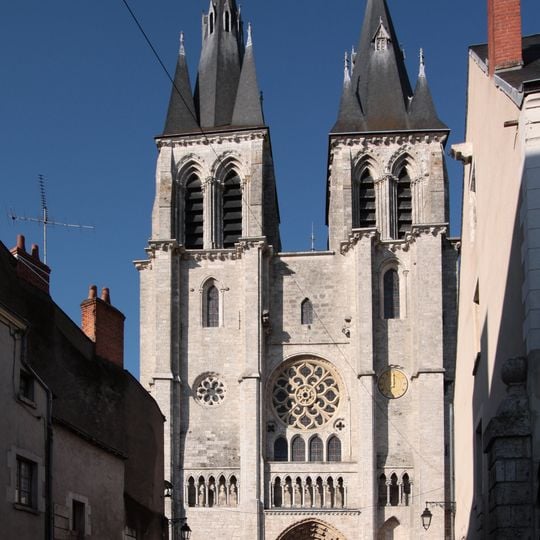
The former Benedictine abbey Saint-Laumer, also called Saint-Lomer, stands on the quai de l'Abbé-Grégoire in Blois. Its church, begun on 25 April 1138, keeps a square pale grey stone tower pierced by a large circular opening and narrow arched bays, flanked by two steep dark slate spires with corner pinnacles and thin finials. The monastic buildings date mainly from the 17th to 19th centuries.
Benedictine monks fleeing Norman raids settled at Blois in 924, when King Raoul granted them the church of Saint-Lubin and land outside the walls. After a fire destroyed that church in 1114, work on the abbey church began on 25 April 1138, and the relics of Saint Laumer and Saint Lubin were placed there on 25 May 1186. Fortified in the 14th century, the abbey was ruined during the Wars of Religion, notably by the Huguenot sack of Blois in 1568, then rebuilt by reformed Benedictines until the early 18th century.
The abbey church, rebuilt by the reformed Benedictines of the Congregation of Saint-Maur after the Wars of Religion, took the name Saint-Nicolas at the Revolution, recalling the demolished Saint-Nicolas du Foix. The former monastic buildings later served as the town's hôtel-Dieu hospital until the 20th century.
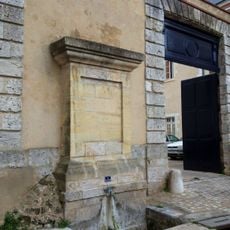
The former abbey stands on the quai de l'Abbé-Grégoire, facing the Loire, and its buildings are now offices awaiting a property project, so there is no visiting programme. The church, which kept a religious role as Saint-Nicolas after the Revolution, is the part to look for; the 1845 guardhouse pavilion and the 1856 garden gate by Jules de la Morandière are protected elements visible from outside.
The abbey church kept a religious role after the Revolution, taking the name Saint-Nicolas in place of the demolished church of Saint-Nicolas du Foix. The monastic buildings became an hôtel-Dieu, which partly spared them from Revolutionary destruction. The site is now unoccupied, awaiting a property project, after housing the departmental directorate for territories and the architecture and heritage unit.
The community of curious travelers
AroundUs brings together thousands of curated places, local tips, and hidden gems, enriched daily by 93,531 contributors worldwide.