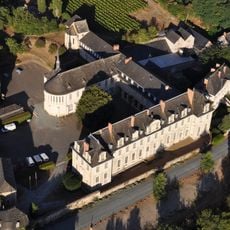
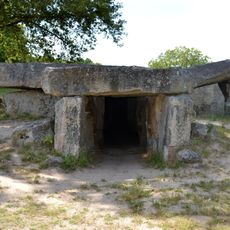
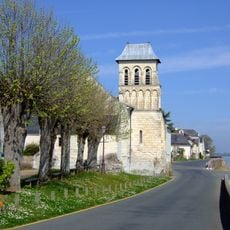
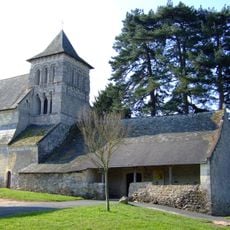
Gennes amphitheatre, Roman amphitheatre in Gennes-Val-de-Loire, France.
The Gennes amphitheatre is a mixed theatre-amphitheatre with a cavea about 94 metres in diameter, its earthen slope held by a rear buttress and stone retaining wall. The elliptical arena measures 43.60 by 38.55 metres, bordered by a low podium wall with gaps for passages. Behind it, a circulation corridor and two curved walls conceal a drainage channel and two service rooms.
The amphitheatre was built during the 2nd century using local stone and tile masonry methods common to the region. Archaeological digs from 1862 to 1901 uncovered the site and revealed details about Roman construction practices of that era.
The cavea, about 94 metres across and holding an estimated 5,000 spectators, was not a full semicircle, a layout shared with the Gallo-Roman site of Montbouy. Near the arena, some tiers were fitted for notables, perhaps with stone seats, while the rest of the slope was earth held by a rear buttress. Wooden seating nails found in the excavations suggest most spectators sat on timber benches.
The arena and cavea sit on the slope of the Mazerolles hill above the Avort stream, so the ground rises toward the rear stone retaining wall. The site can be visited during the summer months; outside that season the grounds are not open to visitors. Allow time to walk the oval and the surrounding excavated area.
Gennes is one of the places proposed for Robrica, a stage on the Peutinger Table between Tours and Angers whose location remains uncertain. The site also includes a nymphaeum, a temple and an aqueduct, and stone sarcophagi burials from the Merovingian period were dug into the theatre itself.
The community of curious travelers
AroundUs brings together thousands of curated places, local tips, and hidden gems, enriched daily by 94,440 contributors worldwide.