Cize-Bolozon viaduct, Road-rail arch viaduct in Ain, France
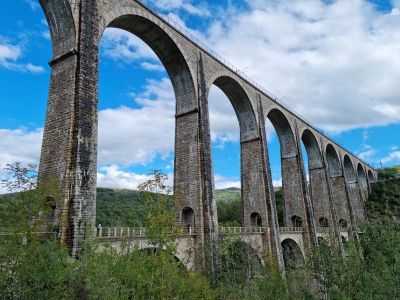
The Cize-Bolozon viaduct is a two-level stone arch structure over the Ain, 273 m long and up to 73 m high, with eleven arches arranged on both decks. The upper level carries the railway between the Racouse tunnel and Cize-Bolozon station; the lower level carries the local road from Poncin to Thoirette. Pale grey masonry with darker weathering frames seven tall semicircular arches above smaller ones, reflected in the water below.
The Compagnie des Dombes et des chemins de fer du Sud-Est began the first viaduct in 1872 and opened it in 1875 for the Ligne du Haut-Bugey, at a cost of 339,000 francs. On 12 July 1944 maquisards blew up pier no. 1; the collapse brought down ten of the eleven arches. Rebuilt from 1945 to 1946, partly by German prisoners, it reopened on 14 May 1950 and was inaugurated on 19 May.
The lower deck carries the local road from Poncin to Thoirette, while the upper deck has carried TGV Lyria trains between Paris and Geneva and TER services from Bourg-en-Bresse toward La Cluse and Oyonnax since December 2010. The name joins Cize and Bolozon, the two communes the viaduct links across the Ain.
The lower deck carries the local road from Poncin to Thoirette, while trains use the upper level between the Racouse tunnel and Cize-Bolozon station. The structure is 273 m long with a maximum height of 73 m, so the best views of both arch tiers and their reflection in the Ain are from the banks below, not from the deck itself.
The viaduct's 11 arches are arranged over two levels, with the lower deck carrying the local road from Poncin to Thoirette and the upper deck the railway. When French Resistance fighters blew up pier No. 1 on 12 July 1944, a domino effect brought down ten of the eleven arches.
The community of curious travelers
AroundUs brings together thousands of curated places, local tips, and hidden gems, enriched daily by 94,003 contributors worldwide.