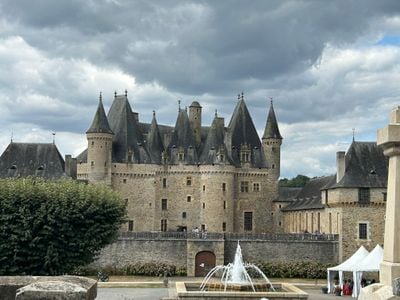
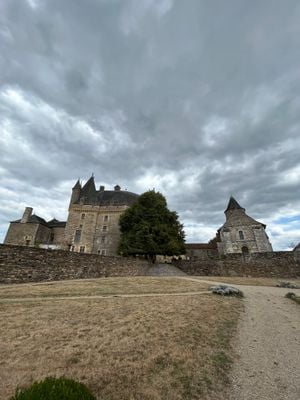
Château de Jumilhac, Renaissance castle in Jumilhac-le-Grand, France.
Château de Jumilhac is a Renaissance castle crowned with tall roofs featuring cone-shaped towers, pepperpot turrets, and pyramidal forms. The exterior walls display seigniorial and alchemical symbols that decorate the entire structure.
A castle stood here from the 12th century; the present building was erected in the 13th and 14th centuries on the site of that earlier fortified castle. It was remodelled in the Renaissance and restructured in the 17th and 18th centuries. Antoine Chapelle, a master ironmaster, married the heiress Marguerite de Vars in 1579, bought out the co-heirs in 1581 and was made Count of Jumilhac in 1597 by Henri IV, whose cause he had financed.
The castle has belonged to the Chapelle de Jumilhac family since the 16th century and to their direct descendants, the de La Tour du Pin family. Antoine Chapelle, a wealthy ironmaster, married the heiress Marguerite de Vars in 1579 and bought the Crevant share in 1581, reuniting the two halves of the seigneurie. Henri IV made him count of Jumilhac in 1597 for financing his bid for the throne.
The private castle, under restoration by its owner, has been open to visitors since 1964. It stands southwest of the village of Jumilhac-le-Grand, about fifteen metres north of the Saint-Pierre-ès-Liens church, above the confluence of the Isle and the Ruchalait. The French-style gardens, redesigned since 1995 after a 1777 model, lie to the southwest along the church and the Isle.
The lead finials on the slate roofs carry allegories that are both seigneurial and alchemical, a link to the site's association with gold and alchemy. The French gardens, relaid from 1995 by the present marquis, follow a 1777 model and take up the same themes. The castle served as a filming location for Le Pacte des loups in 2001 and for Kaamelott in 2024.
The community of curious travelers
AroundUs brings together thousands of curated places, local tips, and hidden gems, enriched daily by 93,486 contributors worldwide.