Théâtre Le Ranelagh, Historic theatre in 16th arrondissement, Paris, France
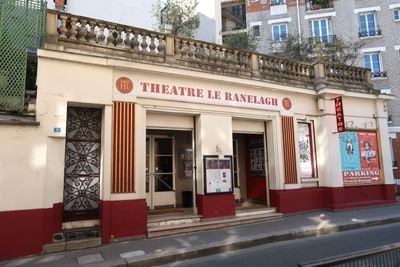
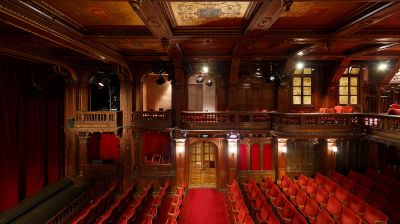
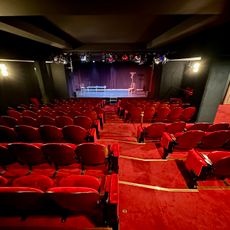
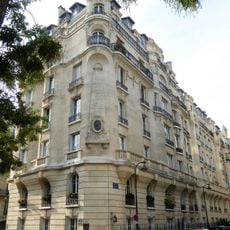
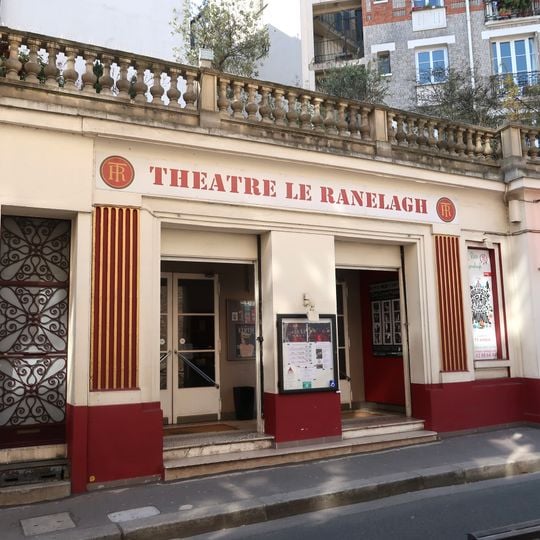
Théâtre Le Ranelagh occupies a cream-coloured corner building at 5 rue des Vignes, its flat roofline topped by a stone balustrade of repeated columns. Red lettering reading "THEATRE LE RANELAGH" appears above two shuttered openings, and a vertical black "THEATRE" sign hangs at the corner. Inside, the hall has carved oak panelling and a coffered wooden ceiling and seats 300.
In 1755 Alexandre Le Riche de La Pouplinière built a private theatre at the end of his Boulainvilliers estate, where Voltaire and Rameau were among his guests. Louis Mors replaced it in 1894 with a music room by Alban Chambon, inaugurated on 14 May 1895 with Girard's L'Épreuve suisse. It became a cinema in 1931 and a theatre in 1985.
The theatre stands on rue des Vignes in the 16th arrondissement, a street laid out when the Boulainvilliers estate was divided into plots after 1826. Its name comes from the nearby Ranelagh Gardens, themselves named after the London pleasure garden. The hall is one of the few theatres à la française left in Paris, with an oak interior and coffered ceiling listed as a monument historique since 6 October 1977.
The theatre sits in the residential Ranelagh neighborhood of the 16th arrondissement and is easy to reach by metro. Booking in advance is a good idea, as the hall has limited seating and popular shows tend to sell out.
Above the door to the hall, Louis Mors had a Latin motto carved: "Mihi amicisque meis" ("For me and my friends"), which still stands today. The oak room in neo-Flemish Renaissance style, by Alban Chambon, was inaugurated on 14 May 1895 with Casimir Girard's one-act operetta L'Épreuve suisse.
The community of curious travelers
AroundUs brings together thousands of curated places, local tips, and hidden gems, enriched daily by 93,455 contributors worldwide.