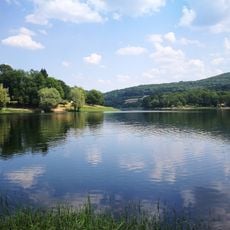
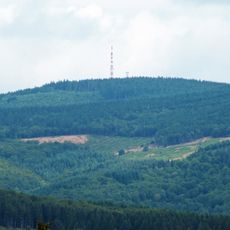
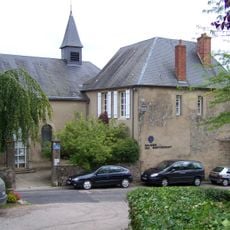
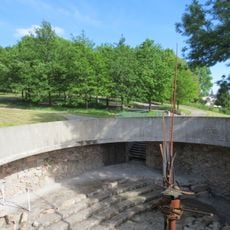
Théâtre gallo-romain des Bardiaux, Roman theatre ruins in Arleuf, France.
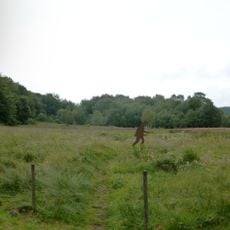
The Théâtre gallo-romain des Bardiaux is a Gallo-Roman theatre built at the end of the 2nd century on the north slope of the Chaz valley. It measures 45 m by 40 m, with a cavea of six concentric terraces about 40 cm high, bounded by a 50 cm thick wall, and an orchestra just over 9 m in radius. The stage building had three rectangular compartments and two doors.
Built at the end of the 2nd century AD on a slope of the Chaz valley, the theatre reused an earlier occupation layer. Dr Lucien Olivier excavated it from 1971 to 1974, uncovering the stage building, the orchestra and the cavea. The site was abandoned in the 5th century under Christian influence and later buried under earth.
Locals knew the site as les Bardiaux, from Beardo; in the 19th century people there believed a town had once stood on the spot, and medals and other objects found were sold to a peddler in 1857. The small theatre, seating 600 to 700, also hosted public meetings and perhaps rituals.
The theatre lies on a north-facing slope at 590 m, with the seating terraces cut into a gradient of about 12%. Access is on foot from Arleuf, 1.7 km to the south-east; the nearest station is at Autun, some 40 km away. The grassed ruins are best walked in dry weather.
A 16 cm statuette of a goddess of Abundance, found on the site and called the Dame des Bardiaux, is kept at the Musée Rolin in Autun. The priest Jacques-Félix Baudiau noted in 1867 that medals and other objects from Les Bardiaux had been sold to a peddler in 1857.
The community of curious travelers
AroundUs brings together thousands of curated places, local tips, and hidden gems, enriched daily by 94,657 contributors worldwide.