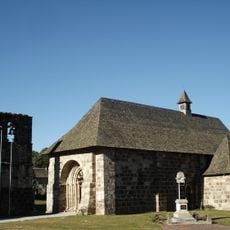
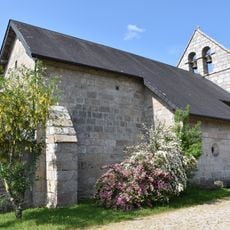
Meymac Abbey, Romanesque abbey in Meymac, France.
Meymac Abbey is a Benedictine monastic complex whose Romanesque bell tower porch, begun around 1085, has eleven carved capitals and a polylobed arch. The nave was built in the late 12th century and its ribbed vault dates from the early 13th century. The church measures 49 metres long, with a 26-metre transept and a 14-metre vault height.
A legend attributes a small church dedicated to Saint Andrew to the hermit Mamacus in the 6th century, consecrated in 546 by Rorice II, Bishop of Limoges. On 3 February 1085 Archambaud III, Viscount of Comborn, founded the Benedictine priory, which became an abbey in 1146 through the contribution of Ebles II of Ventadour. The last monks left on 27 January 1791 and the abbey was sold in successive lots.
The abbey now houses the Marius-Vazeilles Museum with archaeological collections and a contemporary art center within its walls. These two spaces shape how people experience and use the building today.
The two surviving monastic wings and the church frame what is now the Place du Bûcher, where the cloister once stood; the Marius-Vazeilles museum occupies the wing adjoining the church and the contemporary art centre the parallel wing. The abbey church is in Meymac, Corrèze, Nouvelle-Aquitaine, and the building has been listed as a monument historique since 1840.
The church holds a 17th-century baroque organ that still plays during concerts or special events, offering a sound connection to centuries past. This instrument is a rare surviving example of the artistic quality that medieval monasteries could acquire and maintain over the ages.
The community of curious travelers
AroundUs brings together thousands of curated places, local tips, and hidden gems, enriched daily by 95,293 contributors worldwide.