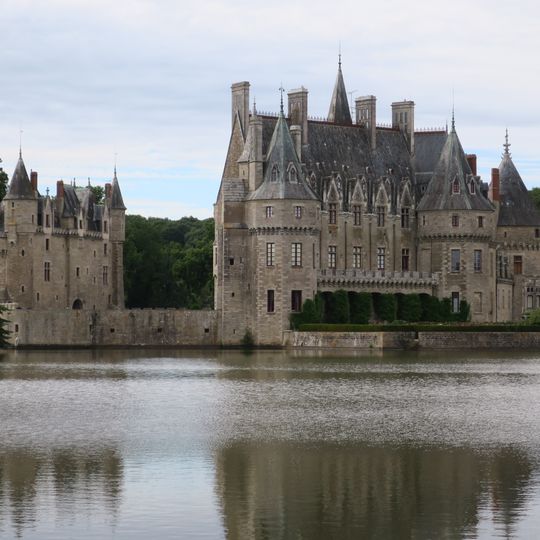
Château de la Bretesche, Medieval castle in Missillac, France.
Château de la Bretesche stands on an irregularly triangular island in a pond at Missillac, reached only by a single bridge that was once a drawbridge. The present building, rebuilt in the 19th century, occupies the eastern part of the island and consists of two main blocks joined by a lower wall; the photograph shows pale grey stone, steep slate roofs, pointed turrets and a balustraded terrace above the water.
A defensive tower stood on the site by the 10th century, and the castle itself was built in the 14th century as an outpost of La Roche-Bernard, then rebuilt in the 15th. In 1558 François de Coligny d'Andelot, who held it through his wife Claudine de Rieux, summoned local nobles here and many converted to Protestantism. It was besieged by the Duke of Mercœur during the Wars of Religion, pillaged and burned in 1793, and rebuilt from 1847 by the Marquis de Montaigu with architects Boismen and Le Diberder.
The site served as a gathering place for regional nobility in the 1500s who came together to discuss religious matters and new ideas. These meetings had lasting effects on the faith of Breton noble families in the surrounding area.
The château stands on a triangular island reached only by a single bridge, once a drawbridge, so access is via that crossing. The former outbuildings now hold a hotel, restaurant and spa, and the 200-hectare park contains an 18-hole golf course. The castle itself is divided into private apartments and is not open to the public.
The name derives from Late Latin brittisca, meaning "British fortification", which by the 10th century had come to designate a defensive tower overlooking a castle's main gate. The castle stands on an irregular triangular island it fills entirely, reached only by a single bridge that was once a drawbridge.
The community of curious travelers
AroundUs brings together thousands of curated places, local tips, and hidden gems, enriched daily by 93,534 contributors worldwide.


