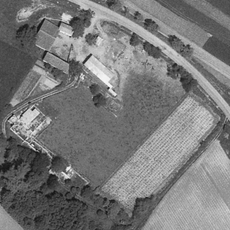
Abbaye d'Arthous, Romanesque abbey in Hastingues, France.
Abbaye d'Arthous is a Premonstratensian monastery founded around 1167 in Hastingues, in the Landes. Its late Romanesque church has a single nave and a three-part chevet whose carved capitals and corbels show geometric motifs, plant interlace, pine cones and round-faced figures with bulging eyes. The conventual buildings, rebuilt in the 17th and 18th centuries after the Wars of Religion, include an abbatial residence and a cloister of the second quarter of the 17th century.
The monastery was founded in 1167 by the Premonstratensians and became an important religious center in the region. During the Religious Wars of the 1500s, the complex suffered significant damage and many medieval records were destroyed.
The name Arthous comes from the medieval Gascon "Artós", from a root meaning holm oak, a tree that dominated the 12th-century landscape; 1970s historians wrongly linked it to King Arthur. The canons kept a necrologue recording benefactors, lost but partly copied by Arnaud Oihénart in 1628 and published by Antoine Degert in 1924.
The abbey stands in the hamlet of Arthous, in the commune of Hastingues, near the borders of the Landes and Pyrénées-Atlantiques. The church was listed as a monument historique on 24 September 1955, the conventual buildings on 24 September 1969. Look for the carved capitals and corbels of the chevet and its apsidioles.
The abbey's medieval cartulary disappeared in the 16th century, so its founding date cannot be fixed precisely; the year 1167 is an estimate. Two partial copies of its necrology survive, one made by Arnaud Oihénart in 1628 and unpublished, the other published by Antoine Degert in the Société de Borda bulletin in 1924.
The community of curious travelers
AroundUs brings together thousands of curated places, local tips, and hidden gems, enriched daily by 93,470 contributors worldwide.