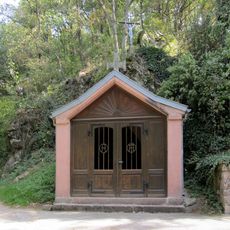
Honcourt Abbey, Benedictine abbey in Saint-Martin, France
Honcourt Abbey was a Benedictine monastery near Saint-Martin, built on the site of an earlier hunting lodge. Its church, begun in 1186 and completed in 1286 under Abbot Conrad III, was circular with an adjoining rectangular choir, resembling the church of Ottmarsheim. The abbess of Andlau ordered its demolition in 1782; nothing remains today.
Founded in 1000 under Emperor Otto III by Count Werner of Ortenbourg, with his brother Hugo as co-founder, the abbey adopted the Hirsau Reform under Abbot Theoger of St. George's (1088–1119). Burgundian troops under Charles the Bold sacked it in 1473–74, and in April 1525 Peasants' Revolt destroyed the conventual buildings. The last abbot, Paul Voltz, converted to Protestantism; the remains were sold to Andlau Abbey in 1599, which demolished them in 1782.
The abbey's name derives from Hugo, its legendary co-founder, whose hunting lodge stood on the site. The Hirsau Reform, introduced by Abbot Theoger of St. George's in the Black Forest, shaped its monastic life. A carved retable, probably by Sixtus Schultheiss, was moved to the church of Villé during the 1525 Peasants' Revolt and later taken by the Lorraine troops.
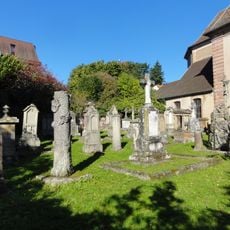
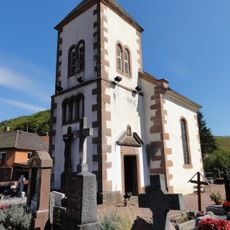
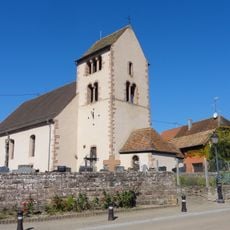
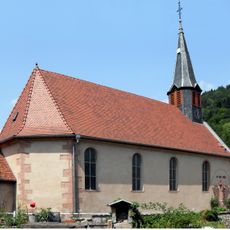
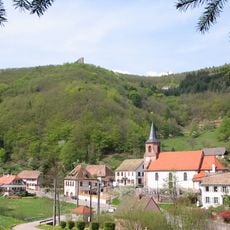
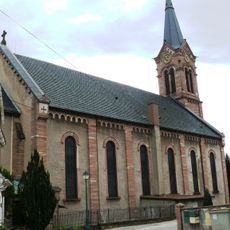
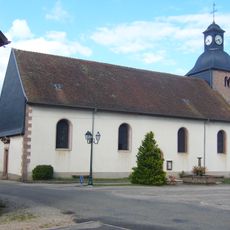
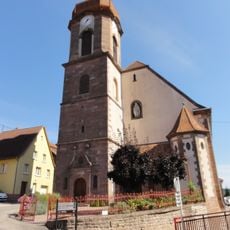
The site is located in Saint-Martin and presents limited accessibility since only archaeological remains are visible on the ground. Visitors should allow time to explore the ruins carefully, as few facilities or marked paths exist on the property.
In 1516 Emperor Maximilian I ordered the tomb opened to test the legend of the giant buried there. The remains were those of Hugo, Count of Reichenberg, not an abbot. A femur measuring 32.48 cm was taken as proof, and multiplying by eight gave a height of 259 cm. The bones of the co-founders Werner and Hugo were found jumbled together.
The community of curious travelers
AroundUs brings together thousands of curated places, local tips, and hidden gems, enriched daily by 94,457 contributors worldwide.