Arras Flying Services Memorial, War memorial obelisk in Faubourg d'Amiens Cemetery, France
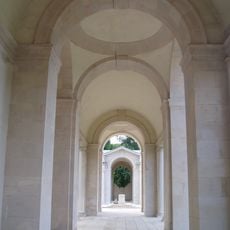
Arras Flying Services Memorial is a pale stone obelisk on a stepped base, its shaft covered with densely packed names and topped by a carved block with a wreath motif that supports a sculpted urn. It stands within a curved colonnade of round columns in Faubourg d'Amiens Cemetery. The four sides of the obelisk are inscribed with the names of 990 airmen.
The memorial was unveiled on 31 July 1932 by Marshal of the Royal Air Force Hugh Trenchard, after the ceremony was postponed from 15 May following the assassination of French President Paul Doumer. It commemorates 990 airmen of the Royal Naval Air Service, Royal Flying Corps and Royal Air Force killed on the Western Front with no known grave. The site was designated after the war when the French graves were moved and the vacant land was used for the Arras Memorial and this obelisk.
The memorial's name is carved on the obelisk along with the badges of the Royal Naval Air Service, Royal Flying Corps and Royal Air Force, and the shields of Canada, Australia, New Zealand and South Africa. Among the 990 airmen named is Lanoe Hawker, the first British flying ace, killed in a duel with Manfred von Richthofen in 1916.
The cemetery is open daily and has multiple entrances, including a wheelchair-accessible gate at Rue Berthe Warret for easier navigation. Wear comfortable shoes since the grounds cover a substantial area that invites walking.
The bronze globe crowning the obelisk is positioned to show the exact astronomical location of Earth on November 11, 1918. This careful detail transforms the memorial into a moment literally frozen in stone and metal.
The community of curious travelers
AroundUs brings together thousands of curated places, local tips, and hidden gems, enriched daily by 93,669 contributors worldwide.