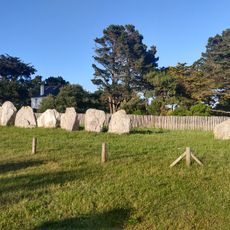
Alignements de Kerbourgnec, Neolithic stone row in Saint-Pierre-Quiberon, France.
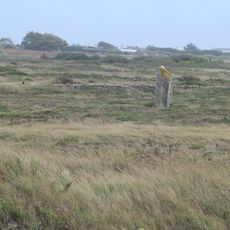
The Alignements de Kerbourgnec is an archaeological site with five parallel rows of standing stones extending roughly 60 meters, currently displaying 23 visible menhirs arranged in a deliberate pattern. The stones follow a precise layout that suggests organized practices from the Neolithic period.
The site originates from the Neolithic period as a place for ritual or community gatherings among early societies. In the late 19th century, French authorities took control and re-erected many fallen stones using methods similar to those applied at Carnac.
The name Kerbourgnec comes from Breton: ker (village) and brenn (hill). The site is also called alignements du Moulin or de Saint-Pierre. The visible rows result from Félix Gaillard's late 19th-century restoration; before it, Lukis's plan showed only two aligned stones. The cromlech, about 40 stones up to 1.8 m high, opens east and lies roughly 150 m southwest of the rows.
The stones are reached via a designated footpath that runs from the main area to a nearby menhir enclosure. The path is straightforward to walk and lets visitors explore the stone arrangement from multiple angles.
Underwater surveys revealed around 150 submerged monoliths extending the site roughly 600 meters into the sea. These sunken stones indicate that the archaeological importance of this place is far greater than what is visible on land today.
The community of curious travelers
AroundUs brings together thousands of curated places, local tips, and hidden gems, enriched daily by 93,662 contributors worldwide.