Allée couverte de Kerbalannec, Megalithic burial site in Brittany, France
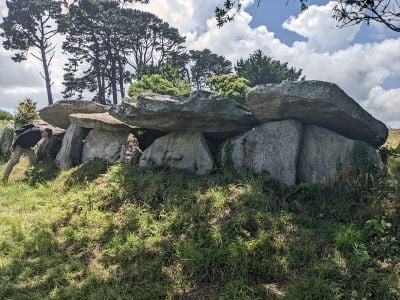
The Allée couverte de Kerbalannec is a gallery grave about 11 m long, oriented south-southeast to north-northwest, with eight upright stones on each side and one at each end supporting five roof slabs; the largest slab measures 2.75 by 2.80 m. Headroom averages 1.90 m, and the width runs from 1.90 m at the entrance to 2.20 m in the middle and 1.50 m at the back. A transverse slab leaves a passage of barely 0.50 m, preceded by a short vestibule, and a line of twelve low blocks runs parallel to the western wall.
The gallery grave was excavated in 1879 by Paul du Châtellier, who found a fill of clay, ashes and charcoal beneath the slabs. It was classified as a monument historique on 10 January 1924. The pottery he recovered includes three round-bottomed vases, a flat-bottomed bowl, two flowerpot-shaped vessels attributed to the Seine-Oise-Marne culture and sherds of at least three Beaker vessels.
The site shows how prehistoric communities in Brittany buried and honored their dead through collective graves. The structure reflects the religious beliefs of the era, where communal burial places held deep meaning for the living.
The monument is located outdoors and accessible via marked paths that begin from the nearest parking area. The paths are straightforward to follow, though sturdy footwear is recommended, especially in wet conditions.
The monument is also called Ti ar C'horriged, "the Korrigans' house" in Breton, after the small fairies of local folklore. It stands in a field boundary, and about 1.30 m from the western wall posts a line of twelve stone blocks protrudes 0.40 m from the ground, probably a peristalith that once held the mound.
The community of curious travelers
AroundUs brings together thousands of curated places, local tips, and hidden gems, enriched daily by 93,847 contributors worldwide.