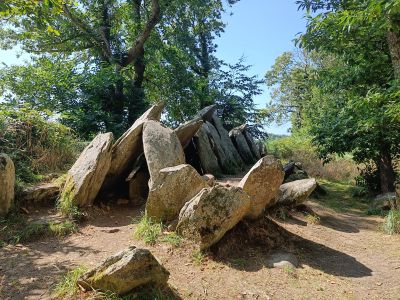
Lesconil gallery grave, Neolithic gallery grave near Poullan-sur-Mer, France
The Lesconil gallery grave is a Neolithic stone burial chamber near Poullan-sur-Mer with a long internal corridor. The structure consists of standing stones forming a stone vault and originally functioned as a burial space.
The monument was first mentioned by M. Halleguen, and Abbé Jean-Marie Abgrall gave the first description and dug there in 1881. In August 1891 Abgrall and Paul du Châtellier carried out a fuller excavation, finding two Bell Beaker vessels, pottery fragments, a polished diorite axe, a fibrolite axe, a diorite hammerstone, a grain-grinding stone and a schist arrowhead. Classified as a monument historique by decree of 18 March 1922, it was bought by the State in the early 1970s.
The site carries the Breton name Ti ar C'horriked, reflecting local beliefs about supernatural dwellings in regional folklore. This name connects the physical structure to ancient stories that remain part of the area's identity today.
The monument lies about 200 m north-east of the top of the hill, at roughly 78 m altitude, on the Poullan-sur-Mer side; the surrounding cairn has been removed, so the stones stand in open ground. Approach on foot from the nearby lanes; no visitor facilities are recorded at the site.
This gallery grave is of the arc-boutée type, found only in Brittany: the side slabs lean against each other and meet at the top, with no horizontal capstone. Around it, 27 stones form a peristalith that once held a cairn, now gone; the slabs are granodiorite.
The community of curious travelers
AroundUs brings together thousands of curated places, local tips, and hidden gems, enriched daily by 94,629 contributors worldwide.