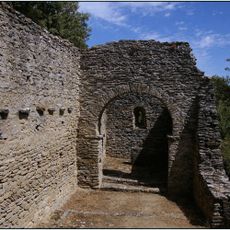
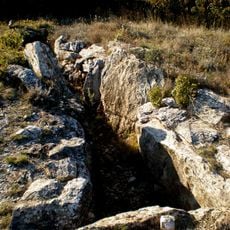
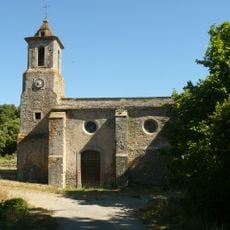
Allée couverte de Saint-Eugène, Neolithic gallery grave in Laure-Minervois, France.
The Allée couverte de Saint-Eugène is a gallery grave in Laure-Minervois, Aude, oriented south-north and measuring 16 m long by up to 3 m wide. It has three parts: a 4 m corridor raised about 0.40 m above a 5.60 m antechamber that widens toward the back, and a 5 m burial chamber, with a holed slab between the last two. The whole is enclosed in a circular tumulus 22 m in diameter, edged by 20 upright slabs.
This grave was built about 5,000 years ago when communities in the region began constructing megalithic monuments. In the early 1900s, archaeologists explored the site and discovered objects showing that people buried their dead here over a long period of time.
The grave held the remains of about 300 people, buried with copper daggers and awls, an ovoid gold bead, barbed flint arrowheads, obsidian blades, 17 green schist palettes and pierced shells of the porcelaine genus. Roman amphora fragments show the chamber was entered in antiquity. The site lies among Aleppo pines near the Allée couverte de Jappeloup.
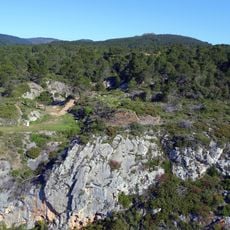
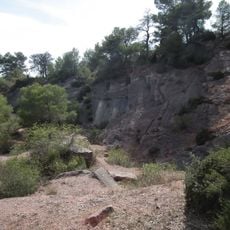
The monument stands in a grove of Aleppo pines in Laure-Minervois, near Carcassonne. The chamber is entered from the south and runs north; the covering slabs are gone, so the passage lies open to the sky. The nearby Allée couverte de Jappeloup can be visited on the same outing.
The covering slabs that once rested on the orthostats have all disappeared, so the chambers now lie open to the sky. In the northeast corner an orthostat was doubled by a support protruding 0.25 m from the ground. The monument was already violated in Roman times, as amphora fragments found there show.
The community of curious travelers
AroundUs brings together thousands of curated places, local tips, and hidden gems, enriched daily by 93,550 contributors worldwide.