Carrière de marbre gris de Caunes-Minervois, Historic marble quarry in Caunes-Minervois, France.
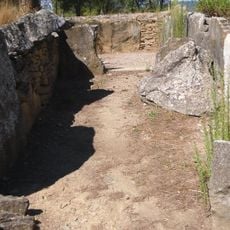
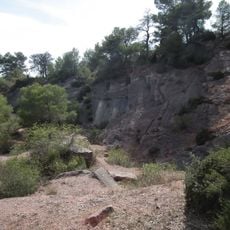
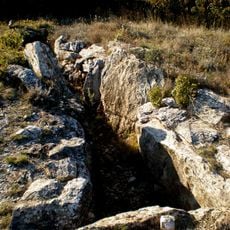
The Carrière de Marbre Gris de Caunes-Minervois is a grey marble quarry cut into a pale grey rock face of angular, faceted planes split by deep vertical and diagonal fissures, mottled with darker grey, white and rust-orange patches. The working area includes cutting benches following the rock's dip, trenches left by removing thick slabs, and berceaux de colonnes where columns were roughed out. A path carved into the rock leads to a platform filled with waste from later operations.
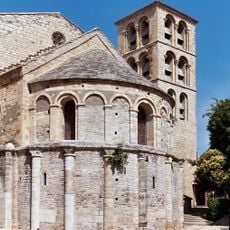
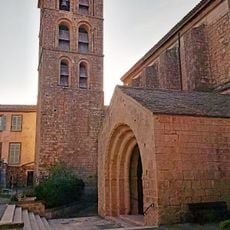
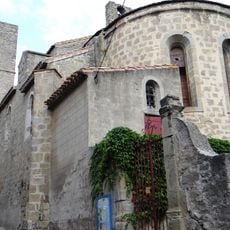
Romans and Visigoths quarried marble at Caunes, and in the 9th century grey marble columns from Caunes were used by the Arabs in the Great Mosque of Cordoba. During the Middle Ages the stone served mainly as building material, as in the early 11th-century chevet of the abbey church, where small grey and red marble blocks alternate. In the early 17th century Abbot Jean d'Alibert and his successor Sernin de Narbonne brought Italian marble workers to develop the quarry.
The gray marble extracted here appears in multiple shades such as agate gray, anthracite gray, and the local cevenol variety with ochre veining. These different types have shaped the appearance of historic buildings across the wider region.
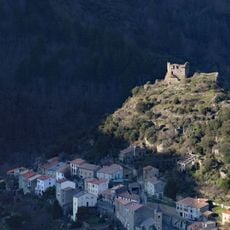
The site lies about two kilometers north of Caunes-Minervois village and is reached via the quarry path. Sturdy footwear is advisable since the ground is uneven, and weather protection helps during visits.
A restored helical wire system on the site shows visitors how stone was once extracted using mechanical techniques. This equipment reveals the ingenuity workers needed when handling heavy blocks without modern machinery.
The community of curious travelers
AroundUs brings together thousands of curated places, local tips, and hidden gems, enriched daily by 94,562 contributors worldwide.