Archéodrome de Beaune, Archaeological museum in Merceuil, France.
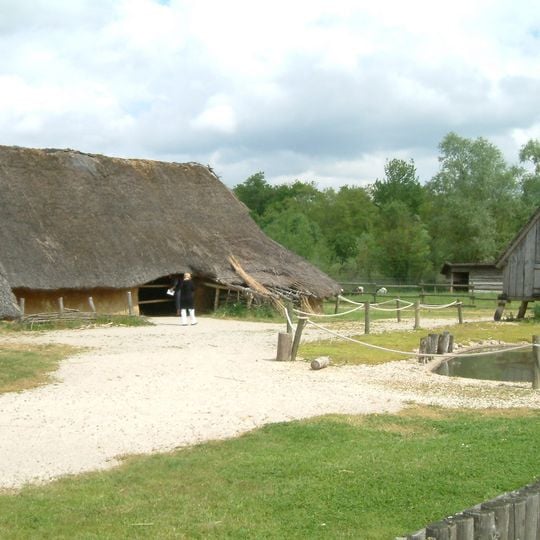
The Archéodrome de Beaune was an open-air archaeological museum in Merceuil, beside the A6 motorway. Its grounds held about ten reconstructions, including a Neolithic dwelling of wattle and straw (4000 BC), a Gallic farm, a fanum from the 2nd century, a potter's workshop, and Roman fortifications copied from those at Alésia.
The Archéodrome opened in 1978 at the Beaune-Merceuil motorway area, created jointly by the Autoroutes Paris-Rhin-Rhône company and Burgundy's regional archaeology service. It drew over 250,000 visitors a year in the early 1980s, then fell to 40,000 in 2004, 17,000 of them schoolchildren. It closed on 31 October 2005 for lack of a buyer and was demolished in February 2025.
The park's reconstructions included a Gallic farm, a 2nd-century fanum (Gallo-Roman temple), a potter's workshop and stelae from a Gallo-Roman cemetery of the 1st to 4th centuries. Researchers demonstrated manual techniques to the public in on-site workshops, and the archaeological heritage of Burgundy was highlighted through remains from Solutré, Vix and Alésia.
The museum sat directly beside the A6 highway, making it a convenient stop during longer drives through the region. The outdoor layout required visitors to walk across open grounds, so appropriate footwear and clothing for changeable weather conditions were advisable.
Researchers demonstrated manual techniques to the public in on-site workshops, showing how horn, bone, flint, bronze and iron were worked. The outdoor park held about ten reconstructions, among them a Neolithic dwelling of wattle and straw dated to 4000 BC, a Gallic farm, a 2nd-century fanum and stelae from a Gallo-Roman cemetery of the 1st to 4th centuries.
The community of curious travelers
AroundUs brings together thousands of curated places, local tips, and hidden gems, enriched daily by 94,042 contributors worldwide.