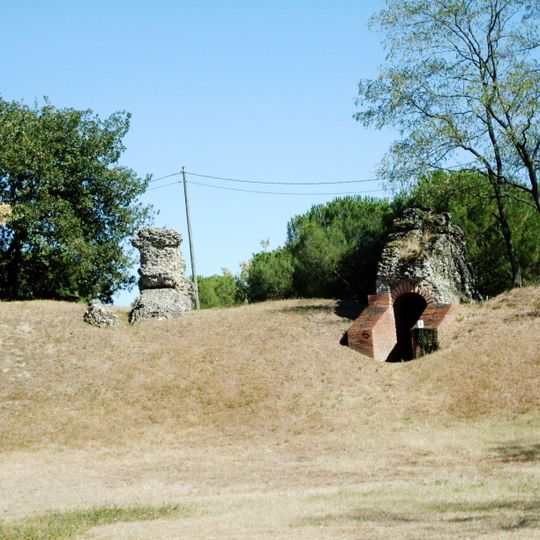
Roman amphitheatre of Purpan-Ancely, Roman amphitheatre in Toulouse, France.
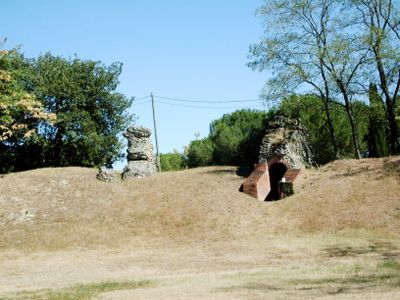
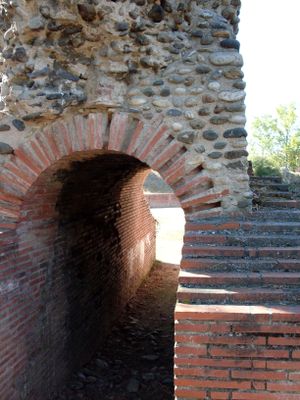
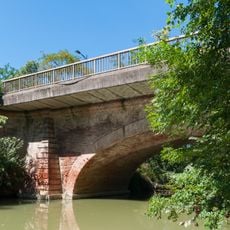
The Roman amphitheatre of Purpan-Ancely is a brick-built structure measuring 115 m long, with an almond-shaped arena of 62 m by 46 m. Its cavea, 15 m wide, carried two tiers of seating and 22 vomitories 1.10 m wide and 1.80 m high. The surviving masonry includes a curved wall with a brick arch and a vaulted passage, plus a flight of brick steps.
Built between AD 40 and 50 under the emperor Claudius, the amphitheatre served a small rural settlement near Roman Tolosa. In the 3rd century radiating walls 7 m long raised capacity from 7,000 to 12,000 spectators; these additions were removed before the second quarter of the 4th century, perhaps after a collapse. Abandoned from the 5th century, it was recorded in the 16th century as the "aire de la tuilerie contentieuse", its bricks taken by neighbours, and later used as farmland.
The amphitheatre brought together people from all levels of Roman society to watch entertainment and witness public spectacles. The arrangement of seats reflected the social order that governed daily Roman life.
The site lies at the crossroads of avenue du Professeur-Guy-Espagno and avenue des Arènes-Romaines, between Purpan and Ancely west of Toulouse, and is open to the public since the 1980s. The ground is irregular, with loose stones and dry earth under the vaulted passage, so wear sturdy shoes.
The arena was cut about 2.5 m into the ground and the cavea rested partly on the spoil heaps, a technique also used at Pompeii and Mérida. At least six brick workshops are attested by stamps on the bricks, and the facade's alternating blind and open exedrae recall the amphitheatres of Avenches and Ivrea.
The community of curious travelers
AroundUs brings together thousands of curated places, local tips, and hidden gems, enriched daily by 93,528 contributors worldwide.