Place d'Alliance, 18th-century royal square in Nancy, France
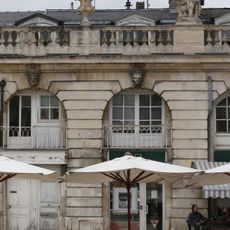
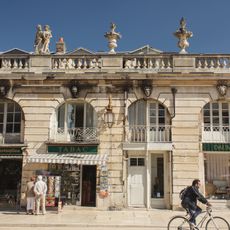
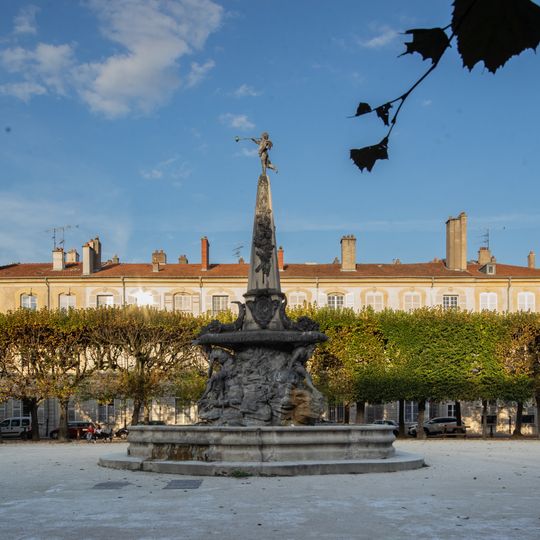
Place d'Alliance is a rectangular square in Nancy, about 80 by 60 metres, laid out by architect Emmanuel Héré and bordered by uniform three-storey townhouses. Its centre holds a fountain by Paul-Louis Cyfflé: a lobed stone basin, a rocky mound with three bearded river figures, and a tapering obelisk crowned by a figure blowing a trumpet. Rows of lime trees planted in 1763 line the square.
Stanislas Leszczynski, Duke of Lorraine, ordered the square built in 1751 on the site of the former ducal kitchen garden, itself laid out on the dismantled Saint-Jacques bastion. Emmanuel Héré designed it as Place Saint-Stanislas, but it was soon renamed Place d'Alliance after the 1756 treaty between Louis XV and Maria Theresa of Austria. During the Revolution it became Place de la Renommée, then Place Chalier.
The name commemorates the 1756 alliance treaty between Louis XV and Maria Theresa of Austria. The fountain by Paul-Louis Cyfflé carries Latin mottoes on its medallion and reliefs, among them "Perennæ Concordiæ Fœdus Anno 1756", and allegorical bearded figures pour the water. Lime trees planted around 1763 still line the square.
The original stone pavement is easy to walk on, and benches are scattered under the lime trees throughout the space. The square remains open and accessible year-round without requiring special facilities to enjoy a visit.
The fountain was first meant for the nearby Place de la Carrière before being erected here. Its sculptor, Paul-Louis Cyfflé, drew heavily on Bernini's Four Rivers fountain in Rome. Latin mottoes on the medallion and reliefs celebrate the 1756 treaty, including "Perennæ Concordiæ Fœdus Anno 1756".
The community of curious travelers
AroundUs brings together thousands of curated places, local tips, and hidden gems, enriched daily by 94,412 contributors worldwide.