Beffroi de Millau, Belfry in Millau, France
The Beffroi de Millau consists of a square keep 21 m high and 10.60 m on each side, built of regularly coursed blue-grey limestone, topped by an octagonal tower of the same height in ochre sandstone. The keep's round-arched vaults and windows are framed in ochre limestone; the octagonal stage has pointed-arch windows and a terrace reached by a stair in its adjoining turret. The keep's flat top, without a spire since 1811, rises behind the lower roofs.
The square tower is the remnant of a palace documented in 1172, built to express the sovereignty of the King of Aragon. On 1 April 1187 Alfonso, king of Aragon and count of Barcelona, granted Millau its communal liberties. The consuls bought the tower in 1613 and added the octagonal bell tower in 1614-1617; the square part served as the communal prison from 1790 to 1818.
The name "beffroi" refers to the communal bell tower added in 1614–1617 to house the town bell and clock. The square tower below had been the palace of the kings of Aragon; after the consuls bought it in 1613, the ensemble became a symbol of municipal authority. The octagonal tower is built of ochre sandstone, typical of 17th-century Millau.
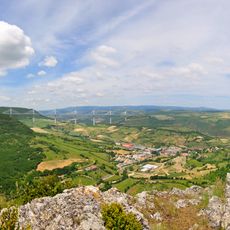
A lateral staircase built after the 1811 fire leads up to the terrace at 42 metres, from which the town, the causses foothills and the Millau Viaduct are visible. The tower stands on rue du Beffroi, about 2 metres from the Hôtel de Tauriac.
Originally the tower had a pointed spire extending much higher, but it was destroyed by lightning and never rebuilt to its original height. This missing spire shapes how the tower looks today and serves as a reminder of how nature can alter even solid structures.
The community of curious travelers
AroundUs brings together thousands of curated places, local tips, and hidden gems, enriched daily by 94,657 contributors worldwide.