Calvary at Guéhenno, Monumental calvary in Guéhenno, France
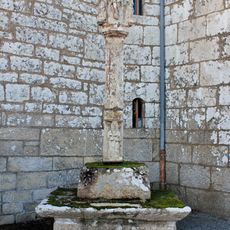
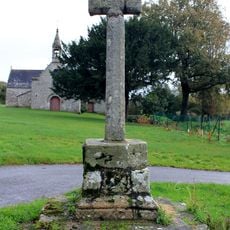
The Calvary at Guéhenno is a monumental calvary of pale tan and grey granite, built in 1550 as two stacked stone masses on a two-step platform. Three crosses rise from the upper platform: a central cross with Christ flanked by the two robbers' crosses. The pedestal carries bas-reliefs of the Passion, including a horseman, and three robed statues stand at the front base. An inscription reads "QUI FAIT LE BIEN PRIEZ POUR NOUS".
Parishioners commissioned the calvary, erected in 1550 by master builder Guillouic in local fine-grained beige granite; an inscription under the upper tier's cornice names him and the year. In 1793–1794 Republican troops burned the 16th-century church and broke the calvary's crosses and statues, though parishioners had dismantled and hidden the damaged pieces. From 1853 rector Charles-Marie Jacquot, aided by vicar Laumailler and masons, reassembled and re-erected it, adding a paving and boundary stones in 1855 and new statues from 1856.
The pedestal displays carved stone reliefs showing scenes from Christ's Passion, including Jesus in the Garden of Gethsemane and Roman soldiers. Visitors can still recognize these scenes today and understand how the community honored these sacred moments in stone.
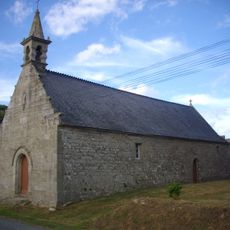
The monument stands between the towns of Vannes and Josselin and is part of a religious complex that includes the village church, an ossuary, and the cemetery. The site is easily accessible on foot from the village center.
After severe damage, the monument was restored in 1853 by Father Jacquot, who skillfully combined original stone fragments with new carvings. This restoration created the appearance we see today and demonstrates how past fragments were woven together with fresh craftsmanship.
The community of curious travelers
AroundUs brings together thousands of curated places, local tips, and hidden gems, enriched daily by 94,257 contributors worldwide.