Saint-Claude Cathedral, Gothic cathedral in Saint-Claude, France.
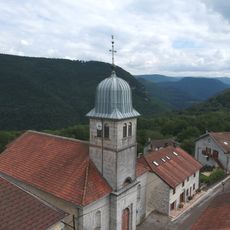
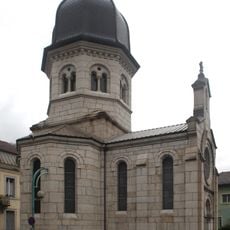
Saint-Claude Cathedral is a Gothic church with a light grey ashlar facade and two asymmetrical towers: a taller spired tower on the left and a shorter, thicker spired tower on the right. The lower central body has a steep gabled roofline with pinnacled corners and tall pointed-arch windows with dark tracery. Its facade was completed in the 18th century with a Baroque upper section, and the south choir stalls, carved by Jehan de Vitry in the mid-15th century, were rebuilt almost identically after a 1983 fire.
The cathedral succeeds Condat Abbey, founded around 415 by Saint Romain du Jura. Construction of the Gothic church began between 1384 and 1392 under abbot Guillaume de La Baume, with the apse finished by 1421 and work on the nave and facade continuing until 1470. Louis XI gave funds to complete it, and in 1742 the abbey was secularised and the church became a cathedral.
The choir stalls were carved in the mid-15th century by Jehan de Vitry; the south side was rebuilt almost identically after a 1983 fire. Since 1952 the church has held the rank of minor basilica, granted by Pope Pius XII, and the basilica's insignia are displayed in the choir.
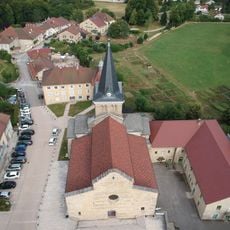
The cathedral stands in the town centre of Saint-Claude, in the Jura department. It has been classified as a monument historique since 30 October 1906. A commemorative plaque at the entrance records its elevation to minor basilica by Pope Pius XII in 1952, and the basilica's insignia are kept in the choir.
The relics of Saint Claudius of Besançon lie in a reliquary made by the goldsmith Goudji. The cathedral also keeps a commemorative plaque at its entrance recalling its elevation to minor basilica by Pope Pius XII in 1952, and the basilica's own insignia are displayed in the choir.
The community of curious travelers
AroundUs brings together thousands of curated places, local tips, and hidden gems, enriched daily by 95,283 contributors worldwide.