Chapelle Sainte-Paix, Romanesque chapel in Caen, France
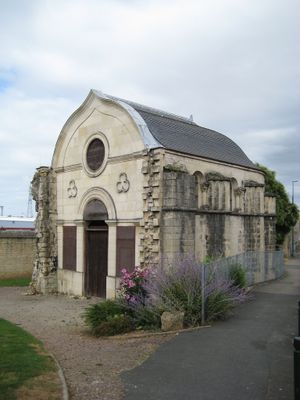
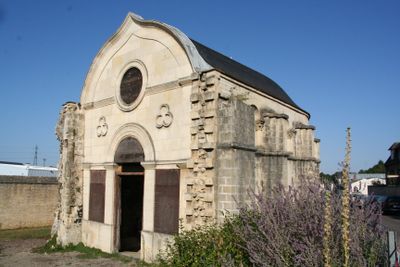
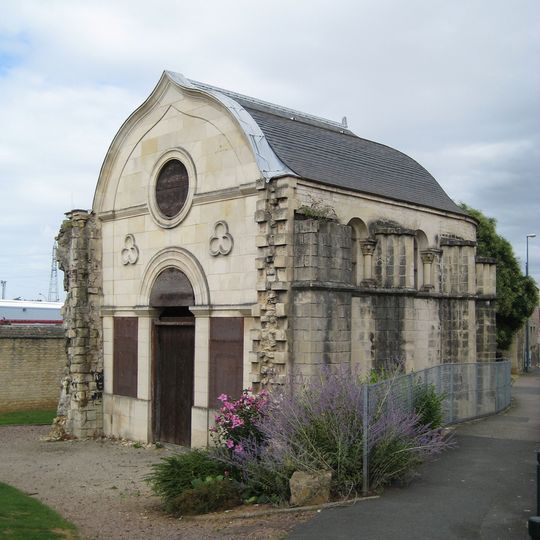
Chapelle Sainte-Paix is a small stone chapel on Rue du Marais in Caen, of which only the choir of the 11th-century church survives. Its light masonry facade has a steep dark tiled roof with a curved gable, a round window high in the gable above three carved circular motifs, and an arched doorway with a dark wooden door. The right side shows larger weathered stone blocks with attached columns and arched niches.
The chapel was built in 1061 on the right bank of the Orne River to commemorate an ecclesiastical council where Duke William issued significant laws. It symbolized the connection between secular power and church authority.
The chapel's name recalls the Peace of God and the curfew law imposed at the council held in Caen between 1042 and 1048, which Duke William commemorated by founding the church in 1061. It was also called Toussaints and then Saint-Marc. A bas-relief from the building is now held in the collections of the Musée de Normandie, deposited by the Musée des antiquaires de Normandie. In 2020 the chapel was used as a filming location for the television programme Secrets d'histoire, in an episode devoted to William the Conqueror broadcast on 21 September 2020 on France 3.
The remains of the chapel are located behind Caen's train station and are not always directly accessible. It is best to check beforehand whether guided visits are available or if the site can be viewed.
The chapel was sold by Gaz de France to the city of Caen in 1958 for a symbolic 1,000 francs, about 20 euros in today's money. Only the choir of the church survives, and it opens to the public solely during guided tours. In 2020, the Secrets d'histoire crew filmed sequences here for an episode on William the Conqueror, broadcast on 21 September 2020 on France 3.
The community of curious travelers
AroundUs brings together thousands of curated places, local tips, and hidden gems, enriched daily by 93,645 contributors worldwide.