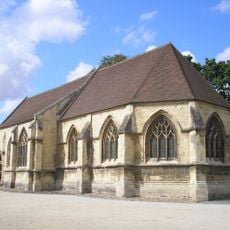
Hôtel-Dieu de Caen, Medieval hospital in Caen, France
The Hôtel-Dieu de Caen was a hospital founded in the 11th or 12th century on rue Saint-Jean, demolished after its transfer to the former abbey aux Dames in the 19th century. Its surviving portal, rebuilt on a facade of the musée des antiquaires, shows a round-headed arch with stone voussoirs and keystone, a panel inscribed "HOTEL DIEU" and a curved pediment crowned by a scroll ornament with a central face.
The first mention of the Hôtel-Dieu dates from 1160, and Henry II of England is considered its true founder, though a predecessor may have been opened by William the Conqueror. In the 19th century the hospital moved into the former Abbaye aux Dames and the original building on rue Saint-Jean was demolished. Its portal was saved and re-erected on a facade of the musée des antiquaires, and has been a listed monument historique since 13 June 1927.
The name Hôtel-Dieu, "God's hostel", marks a house of charity rather than a hospital in the modern sense. Care passed from ten religious brothers to nuns from 1323, and in 1629 the town contracted the Madeleine of Rouen to send a prioress and two sisters. A 1637 papal bull placed those sisters under the Bishop of Bayeux, against the prior's claim.
The former Hôtel-Dieu building on rue Saint-Jean no longer stands; its portal was saved and re-erected on a facade of the Musée des Antiquaires (former Collège du Mont). The portal is a listed monument historique since 13 June 1927. The active hospital today is the Hôpital Clemenceau (CHR), built in the early 20th century, not the portal site.
A notable security feature was the treasury chest secured by two separate locks, with keys held independently by different officials. This system prevented any single person from accessing the valuable holdings alone.
The community of curious travelers
AroundUs brings together thousands of curated places, local tips, and hidden gems, enriched daily by 92,778 contributors worldwide.