Église Saint-Sauveur de Casesnoves, Medieval church in Ille-sur-Têt, France
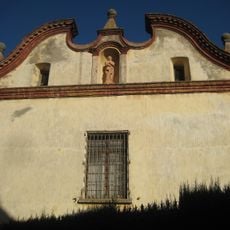
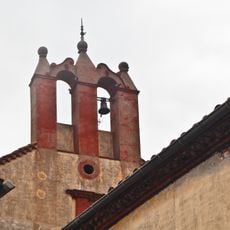
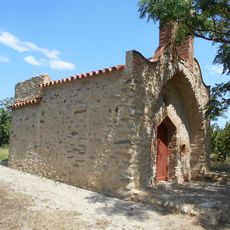
Église Saint-Sauveur de Casesnoves is a small single-nave Romanesque church built of rubble stone and covered with flat stone slabs (lauzes), standing at 161 m in the abandoned hamlet of Casesnoves, 2 km west of Ille-sur-Têt. Its semicircular apse has blind arcading in the Lombard style but no pilaster strips, and a double-splayed window opens at its centre. The nave is roofed with a barrel vault and joins the choir through a very wide triumphal arch; a pink marble door opens in the south wall and a bell gable stands at the west end.
The church was built around 1050, possibly in two phases, and is first documented in 1288 when Ramon Joan is named as its chaplain. In the 13th or 14th century the nave was extended west with a bell gable, a north chapel added, and the south door replaced by a pink marble portal. The parish was merged into Ille in 1561, and the building was sold as national property during the French Revolution. Romanesque wall paintings were rediscovered in 1953 and removed in 1954; the church was listed as a monument historique on 6 June 1955.
The name Casesnoves comes from the Latin Casas novas, meaning "new houses", first recorded in 1076. In the 19th and early 20th centuries, tradition held the church was dedicated to the Spanish saints Just and Pastor, a claim repeated by the local poet Joseph-Sébastien Pons, who called the ruined village his favourite walk.
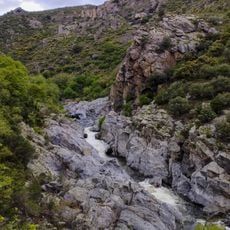
The church stands in the abandoned hamlet of Casesnoves, about two kilometres west of Ille-sur-Têt's centre and under three kilometres from Rodès and Bouleternère, on the left bank of the Têt beside the ravine's cliffs. The building was bought by the commune in 1990 and restored in 1990 and 1992, with walls consolidated and the roof renewed. Approach on foot from the surrounding orchards; the site is a roofless former agricultural store, so plan for uneven ground.
The wall paintings found here are the oldest known Romanesque murals in northern Catalonia, painted in the mid-11th century, slightly before those of Sant Martí de Fenollar. Removed in 1954 after an antiquarian was tipped off, they resurfaced in Geneva in 1978 and are now held by the Abegg foundation near Bern and the Geneva museum; some fragments remain in place.
The community of curious travelers
AroundUs brings together thousands of curated places, local tips, and hidden gems, enriched daily by 94,217 contributors worldwide.