Château de Chenavel, Castle in Jujurieux, France
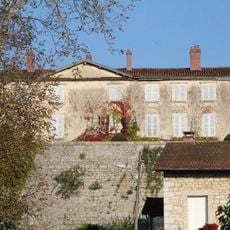
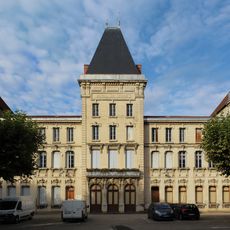
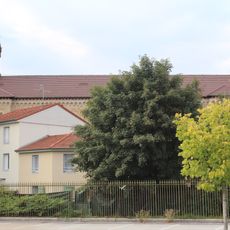
Château de Chenavel stands on a plateau above the Ain, 2.5 km northwest of Jujurieux. The 14th-century fortress was rebuilt from 1590 and lost its feudal look in 1833 with the removal of the east wing, drawbridge and moats. Its pale grey, cracked stone facade has a round tower with a conical roof, a rectangular chimney, a smaller pointed tower and four round openings above three white-mullioned windows.
This castle began as a fortress in the 14th century and was completely reconstructed in 1590 under the direction of the abbot and lord of Ambronay. This transformation changed it from a military stronghold to a residence suited for courtly life.
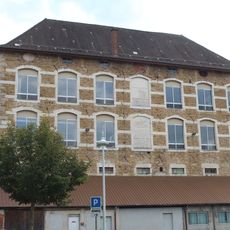
The name Chenavel comes from the Franco-Provençal chenève, from Latin cannabis (hemp), with the suffix -etum. From 1844 Claude-Joseph Bonnet used the castle as a rest home for the women workers of his silk factory in Jujurieux, a role it kept until the early 20th century. In 1949 Bonnet's grandchildren, the Cottin heirs, gave it to a family holiday association.
The castle stands on a plateau 2.5 km northwest of Jujurieux, facing the Château de Thol across the Ain. Since 1949 it has belonged to a family holiday association, which received it as a gift from Claude-Joseph Bonnet's grandchildren. Access is by road from the village; the grounds are private, so visits should be arranged with the owners beforehand.
During the French Revolution, villagers saved this castle from demolition by claiming that destroying it would damage the vineyards surrounding it. This practical argument proved more effective than political protection.
The community of curious travelers
AroundUs brings together thousands of curated places, local tips, and hidden gems, enriched daily by 93,477 contributors worldwide.