Châteauneuf-sur-Epte, Medieval castle in Château-sur-Epte, France.
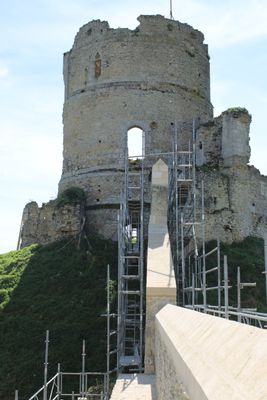
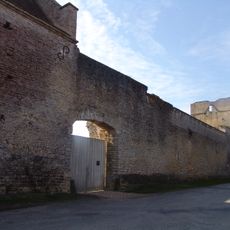
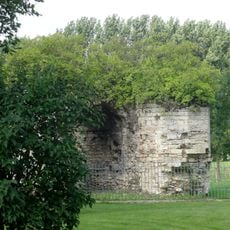
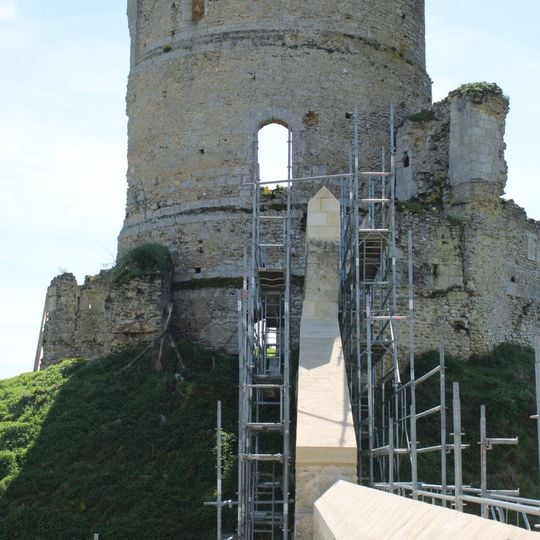
Châteauneuf-sur-Epte is a ruined castle on a motte at the edge of the Vexin plateau. Its circular lower court, about 70 m across, closes onto a truncated motte nearly 50 m wide at ground level. The surviving keep is a tall cylindrical tower of pale limestone, now cut in two, with a round-arched opening high on its face and a straight stone stairway against its lower right side.
Begun in 1097 by William Rufus, king of England, the castle guarded the Epte, the border between the Duchy of Normandy and the French kingdom. Louis VI besieged it in 1119, and in 1153 Louis VII gave it to the Abbey of Saint-Denis. Henry II Plantagenet strengthened it in the 12th century, John Talbot took it in 1437, and Mazarin ordered its dismantling in 1647.
The name Châteauneuf-sur-Epte distinguishes the castle from the older Château-sur-Epte village. Louis VII granted the village a Friday market in 1153 to help it prosper around the frontier stronghold. Since 2015 the Héritage Historique association has organised historical re-enactment camps and battles, and opens the site for the European Heritage Days.
The ruins stand in the centre of Château-sur-Epte, on the edge of the Vexin plateau, downstream of Gisors. Access is not year-round: the association opens the site for the European Heritage Days, for groups on request and during occasional events, and volunteers work on the second weekend of each month. The ground was cleared of dense vegetation from 2016 and masonry consolidation began in 2017.
The castle was occupied by the German army from 1941 to 1944, which installed a large radio relay with a tall transmitting aerial. For a few days in 1944 it housed the command post of the Wehrmacht's 49th Infantry Division under General Macholz. British troops of XXX Corps passed through the village on 29 August 1944 on their way to Gisors.
The community of curious travelers
AroundUs brings together thousands of curated places, local tips, and hidden gems, enriched daily by 94,370 contributors worldwide.