Château de Beauvais, Medieval castle in Lussas-et-Nontronneau, France.
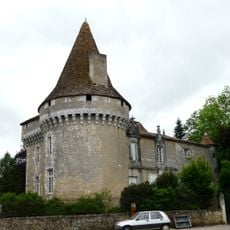
Château de Beauvais is a long rectangular range of pale stone flanked by two large round towers with machicolations, their steep conical roofs covered in reddish-brown tiles; the left tower rises higher. A row of dormers and small windows runs along the central range, and a lower round tower with a conical tiled roof stands in front of the right side, among trees and grass. It overlooks the narrow valley separating it from the village of Lussas.
Construction started in 1533 by the Faure La Roderie family on land previously held by the Mareuil family, lasting about two decades. Later owners preserved the original layout while adapting the property to their needs.
The name Beauvais derives from the Latinised Belverium, or Belver, used for the Templar estate on this hill. After the Templars were arrested in 1307 and their order dissolved in 1312, the domain passed to the Knights of Saint John of Jerusalem. The Cars family chapel in the parish church of Lussas, still owned by the castle, holds the tomb of Gabrielle des Cars, countess of Beauvais, who died childless in 1760.
The castle stands on a height above the narrow valley separating it from the village of Lussas, about 6 km from Nontron in the Périgord vert. It is private property, so visits are not open to the public; the building and its dovecote are inscribed as monuments historiques. The chapel of the Cars, adjoining the Lussas parish church, belongs to the castle.
The castle's water supply came from a 50-metre well cut by hand through limestone, dug before the buildings themselves and vital for the garrison and livestock on the hilltop. The site began as a farming dependency of the Templar commandery of Le Soulet, known in Latin as Belverium.
The community of curious travelers
AroundUs brings together thousands of curated places, local tips, and hidden gems, enriched daily by 94,369 contributors worldwide.