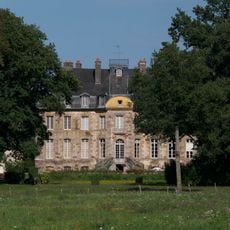
Château de Blossac, 17th-century castle in Goven, France
Château de Blossac is a castle in Goven featuring a central block with four bays and two projecting pavilions flanked by lateral wings. These elements surround a forecourt at the estate entrance, creating the structured layout of the residence.
Louis de La Bourdonnaye, lord of Coëtion and councillor at the Parlement de Bretagne, bought the Blossac land in 1671 and built the present 17th-century château on the site of a 15th-century manor, of which one turret survives. In the 18th century a chapel, blessed in 1769, and an adjoining wing were added; the central door of the east facade is dated 1760. The facades and roofs were listed as monuments historiques on 15 March 1957.
The library panelling came from the Hôtel Julien on Rue Vivienne in Paris, not from the château itself. The name Blossac derives from Bélozac, a 12th-century lord whose Gallo-Roman -acum suffix survives in the altered form. The estate has stayed in the same family since 1671, now through the female line, held by the Gosset de La Rousserie family.
The château stands on an island formed by a canal between the Meu and the Vilaine, at the tripoint of Goven, Bruz and Chavagne, 11 km south-west of central Rennes. The site is prone to flooding: in January 2025 the château's parquet floor was destroyed by an inundation, and the Chavagne road can be cut off. Check conditions before setting out.
The château stands on an island formed by a canal between the Meu and the Vilaine, at the tripoint of Goven, Bruz and Chavagne. A journalist flying over the flooded zone described it shining amid dark groves, its light mirrored in the water. In January 2025 an flood destroyed the château's parquet floor.
The community of curious travelers
AroundUs brings together thousands of curated places, local tips, and hidden gems, enriched daily by 92,796 contributors worldwide.