Château de Blâmont, Medieval castle in Blâmont, France.
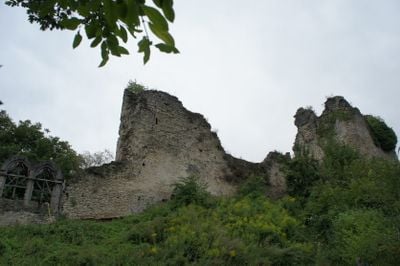
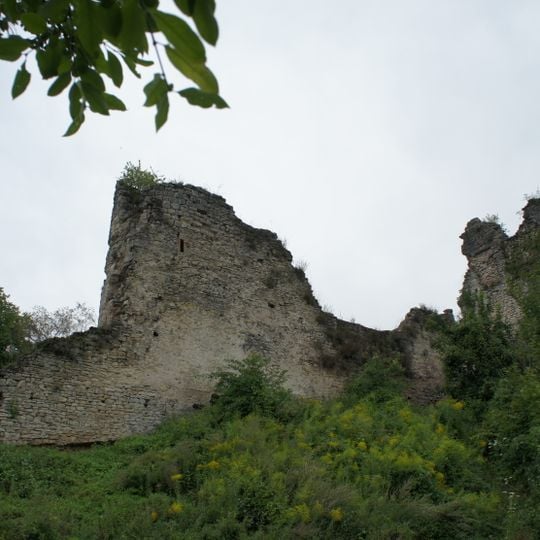
Château de Blâmont is a ruined castle in Blâmont, in the Meurthe-et-Moselle department of Lorraine. Its surviving masonry consists of rough grey and tan stone walls: a tall jagged segment pierced by narrow slits and small rectangular openings, a lower broken wall section to its right, and a further taller fragment separated by a gap. Plants and shrubs grow along the broken tops, and dense vegetation fills the foreground.
Construction of the castle may have begun in the last two decades of the 12th century, as knights bearing the name Blâmont are recorded in 1186. Around 1300, Henri, called "Maus Cerviaux", strengthened the fortifications and surrounded the town with walls. In 1541, François I of Lorraine gave the county of Blâmont as dower to Christine of Denmark, who from 1552 had a Renaissance-style building erected inside the castle enclosure. The medieval castle was partially demolished in 1670 when the French left the duchy, and the site was bombarded by the American army in 1944.
The castle is cared for by the Association Clef de Voûte, which runs volunteer work camps on the site. Participants learn traditional masonry, stone extraction and stone carving while helping maintain the ruins. The association also organises events at the castle, including concerts and exhibitions.
The castle stands in the commune of Blâmont, in the Meurthe-et-Moselle department of the Grand Est region, on the right bank of the Vezouze. The medieval part is a roofless ruin, so the grounds are visited on foot among the surviving walls. Members of the Association Clef de Voûte maintain the site and organise events there.
A chocolate manufacturer named Fernand Burrus purchased the property in 1912 and added two extra towers to the medieval structure. This addition reflects how later owners adapted the fortress to suit their vision.
The community of curious travelers
AroundUs brings together thousands of curated places, local tips, and hidden gems, enriched daily by 93,811 contributors worldwide.