Château de La Roche-Jagu, Medieval castle and park in Ploëzal, France.
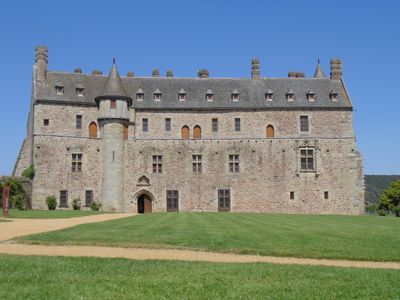
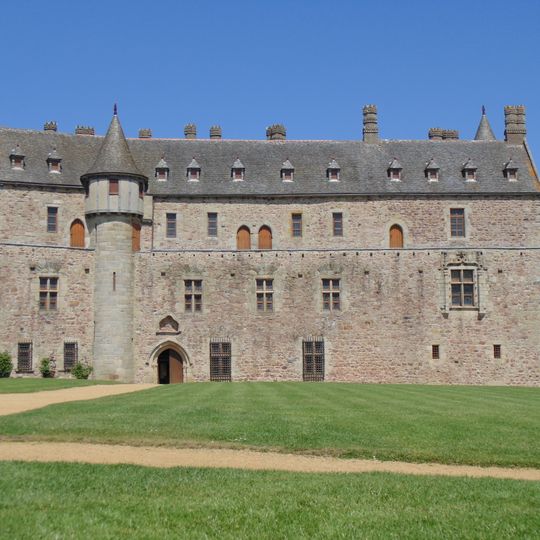
Château de La Roche-Jagu is a 15th-century fortified house in Ploëzal, built as a single deep block whose entrance door is topped by a niche. The first floor keeps its stone mullioned windows, while the recessed upper storey and roof were heavily reworked; the riverside facade retains its wall-walk. The kitchen is the only room preserved in its medieval state.
The oldest parts of this fortified house date from the end of the Middle Ages. In 1773, Marshal de Richelieu sold it to Mme Le Gonidec de Tressan. Viscount Gaëtan d'Ales bequeathed it to the State, and since 1958 the Côtes-d'Armor departmental council has owned it; restoration was carried out in 1968. It was classified as a monument historique on 25 June 1930, and its wall, gate and pavilions on 27 January 1969.
The château houses a temporary exhibition each year, such as flax in 2006 and the odyssey of spices in 2018. The gardens, free to enter, are laid out as medieval-inspired plots: a vegetable garden, a medicinal plant garden and a bouquetier, alongside 350 camellia varieties.
Wear comfortable walking shoes, as the path to the castle involves climbing and the grounds are uneven in places. The park and castle are accessible during daylight hours, and late morning or early afternoon visits offer the best lighting to appreciate the architecture and gardens.
The park's 350 camellia varieties and the wrought-iron sculptures by Marc Didou along the paths to the promontory are not the only artworks: Béatrice Coron's "Voyage Intérieur" stands in the seigneurial garden. The 1987 storm devastated the plantations, and landscape architect Bertrand Paulet then directed their replanting.
The community of curious travelers
AroundUs brings together thousands of curated places, local tips, and hidden gems, enriched daily by 92,801 contributors worldwide.