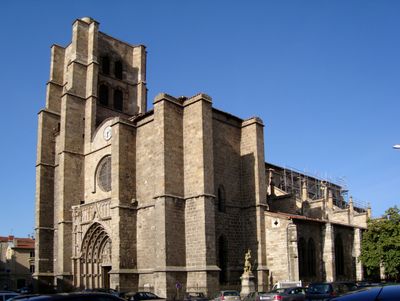
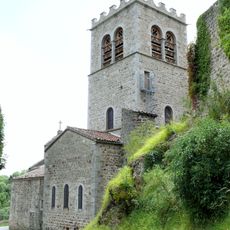
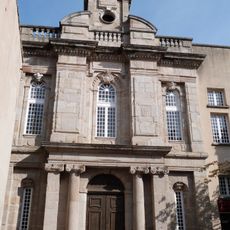
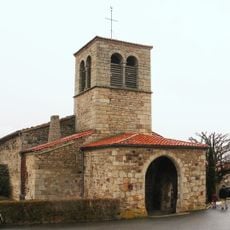
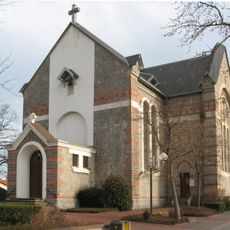
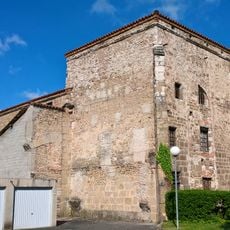
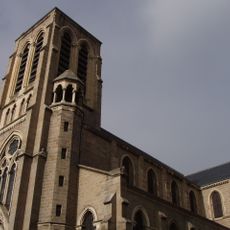
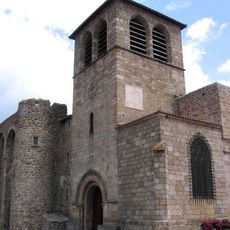
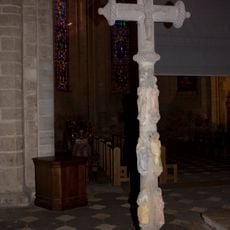
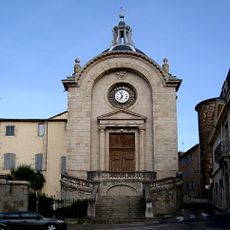
Collégiale Notre-Dame d'Espérance de Montbrison, Gothic church in Montbrison, France.
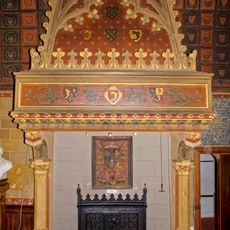
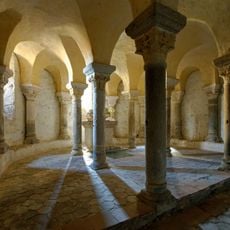
The Collégiale Notre-Dame d'Espérance is a Gothic church in Montbrison arranged with a central nave flanked by side aisles and terminating in a pentagonal apse. The interior space follows the typical structure of churches from this architectural period, creating distinct zones for worship and procession.
Count Guy IV of Forez founded the chapter of Notre-Dame in July 1205 and had the foundation act drawn up at his castle of Moingt in 1223, notified on 15 July before the church of Saint-Julien d'Antioche. Work had begun in 1212 on the right bank of the Vizézy, on marshy ground reinforced with wooden piles. On 23 November 1226 his young son, the future Guy V, laid the honour stone at the back of the apse. The church was completed in 1466.
The church is still an active parish in the Sainte-Claire-Sainte-Thérèse-en-Forez parish of the Diocese of Saint-Étienne. Its name, Notre-Dame-d'Espérance, honours the Virgin Mary. Look for the wall painting of Saint Catherine of Alexandria in the former Sainte-Catherine chapel, now Saint-André, with the canon Clément Rosset kneeling at her feet; the south door was cut into this chapel in 1844.
Access to this church is available through Notre Dame Cloister Street, and it continues to function as an active place of worship within the Saint Claire Saint Therese en Forez parish. Visitors should remember that this remains a working community space with regular worship activities throughout the week.
The foundation stone was laid on 23 November 1226 by the count's young son, the future Guy V, at the back of the apse beneath the axial window. A Latin inscription on the stone records the act and lists the endowment: the lordship of Moingt, the tithe of Verrières and 60 livres from the Montbrison market.
The community of curious travelers
AroundUs brings together thousands of curated places, local tips, and hidden gems, enriched daily by 94,526 contributors worldwide.