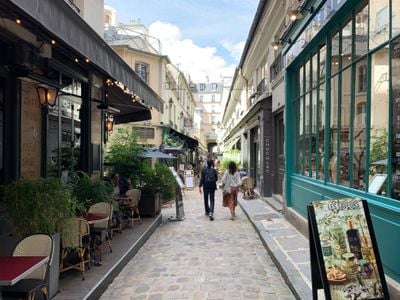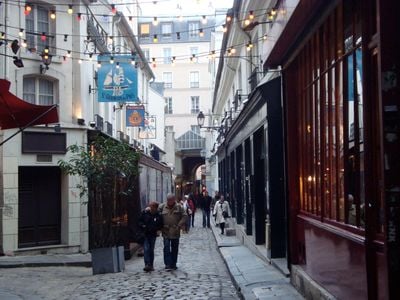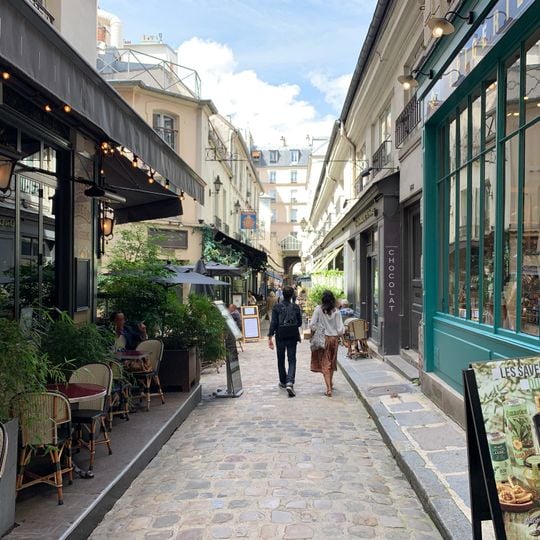
Cour du Commerce-Saint-André, Historic covered passage in 6th arrondissement, France.
Cour du Commerce-Saint-André is a covered passage stretching roughly 120 meters long and 3.5 meters wide, connecting Rue Saint-André-des-Arts to Boulevard Saint-Germain. Multiple restaurants and shops line both sides of the passage, fitting snugly within the confined space.
A first passage was opened in the 1730s between the rue des Fossés-Saint-Germain and the rue Saint-André-des-Arts, then extended around 1776 to the rue des Cordeliers over former jeu de paume courts. Around 1791 a passage was pierced through the remains of Philippe Auguste's wall to the cour de Rohan. In 1866 the piercing of the boulevard Saint-Germain cut about forty metres from it and destroyed Danton's house. It was renamed cour du Commerce-Saint-André in 1877.
The name combines the passage's shops with the former Saint-André-des-Arts church, added in 1877 to distinguish it from other passages du Commerce. At no. 4, a shop still incorporates a section of Philippe Auguste's 12th-century city wall, and the passage leads into the Cour de Rohan. Le Procope, founded in 1684 and Paris's oldest café, opens onto the passage.
The passage runs from Rue Saint-André-des-Arts to Boulevard Saint-Germain, with a side opening to the Cour de Rohan. It is narrow and paved with uneven cobblestones, so watch your step. The Odéon metro station (lines 4 and 10) is nearby. The passage is lined with shops and cafés, and the covered gallery at the Saint-André-des-Arts end offers shelter.
At no. 9, in the workshop of the carpenter Schmidt, Joseph Ignace Guillotin lodged and tried out his guillotine on sheep. The device was later linked to the Revolution, but the experiments were his, not those of his host. The passage also holds remains of the Philippe Auguste wall, visible in a shop at no. 4.
The community of curious travelers
AroundUs brings together thousands of curated places, local tips, and hidden gems, enriched daily by 93,750 contributors worldwide.