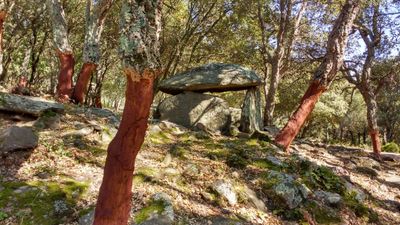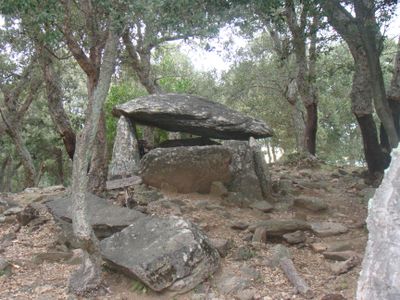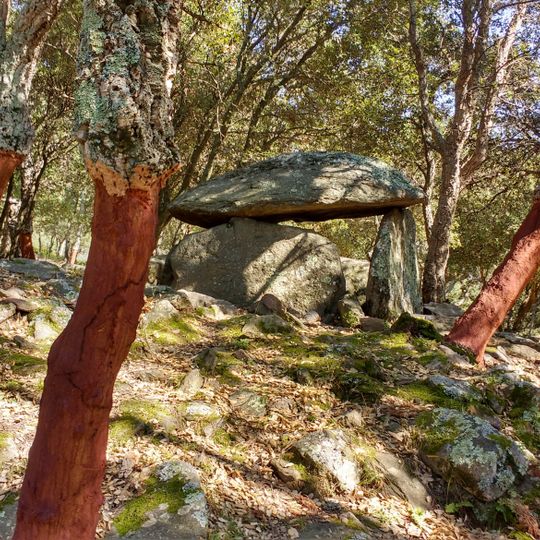
Dolmen de la Siureda, Neolithic dolmen near Maureillas-las-Illas, France.
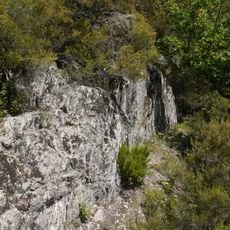
Dolmen de la Siureda is an ancient burial monument made of three vertical gneiss slabs topped by a single capstone, forming a small chamber-like space. The entire structure sits on the Pyrenean slopes at roughly 400 meters elevation.
Built in the second half of the 3rd millennium BC as a collective burial, the dolmen was reused as a shelter or grave in the late Bronze Age, around 1100–700 BC, and again in historic times; it was emptied or looted at an unknown date. Rediscovered in 1985 in a cork oak wood, it was excavated from June 1986 to 1988 by the Groupe de Préhistoire du Vallespir et des Aspres under Françoise Claustre, and first reported in L'Indépendant on 6 October 1986 as the "dolmen de Maureillas".
The name references the local landscape, while the site shows how ancient communities treated their dead as a family responsibility. Visitors can sense the importance placed on burial practices through the careful stone arrangement and the objects left behind.
The site is accessible via a clearly marked hiking trail starting from the nearby village, with yellow waymarks guiding the way. Good footwear is recommended since the terrain slopes upward and can be uneven in places.
The structure has an unusual opening system specifically designed to allow bodies to be placed inside and then sealed, a feature that sets it apart from other burial monuments in the area. This practical arrangement reveals much about how ancient people solved challenges in their funerary customs.
The community of curious travelers
AroundUs brings together thousands of curated places, local tips, and hidden gems, enriched daily by 92,854 contributors worldwide.