Darioritum, Archaeological site near Vannes, France.
Darioritum is the Gallo-Roman name of the present-day city of Vannes, founded at the end of the 1st century BC on the hill of Boismoreau, now the Saint-Patern district. The ancient town spread over about 40 hectares around a port at the junction of three hills. At the end of the 3rd century, its inhabitants withdrew behind a wall on the hill of Mené, built with reused stones from demolished public monuments.
Darioritum was founded at the end of the 1st century BCE, after Caesar's war against the Veneti, when the Roman administration moved the tribe's capital from Locmariaquer to the hill of Boismoreau, now the Saint-Patern quarter of Vannes. The town stood at the junction of six Roman roads and on the route from Lyon to Brest. At the end of the 3rd century, raids by Frisian pirates and Bagaudae bands drove the inhabitants to withdraw behind a wall on the hill of Mené, built in haste from reused public monuments; this 5.5-hectare enclosure remained the city's frame until about 1380.
The name Darioritum is Celtic, built on the Gaulish suffix -ritu, meaning a ford or crossing; the first element may come from daricos, giving the sense of a turbulent ford. Ptolemy placed the city of the Veneti at Darioritum around 140 CE, and the Peutinger Table later records it as Dartoritum. The town stood at a junction of six Roman roads, leading to Locmariaquer, Hennebont, Corseul with a branch to Carhaix, Rennes, Rieux and Arzal with a branch to Port-Navalo.
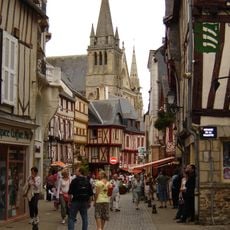
Darioritum lies in today's Vannes, on the north shore of the Gulf of Morbihan. The Gallo-Roman town spread over the Boismoreau hill, now the Saint-Patern district, east of the historic centre. From the end of the 3rd century the inhabitants withdrew behind a rampart on the Mené hill, whose summit is now Place Henri IV.
Darioritum was a road hub where six Roman routes converged: to Locmariaquer, Hennebont, Corseul (branching to Carhaix), Rennes, Rieux and Arzal (branching to Port-Navalo). The name is Celtic, built on the Gaulish suffix -ritu, "ford", which the Breton article reads as "the turbulent ford".
The community of curious travelers
AroundUs brings together thousands of curated places, local tips, and hidden gems, enriched daily by 94,382 contributors worldwide.