Musée de la Cohue, Art museum in central Vannes, France
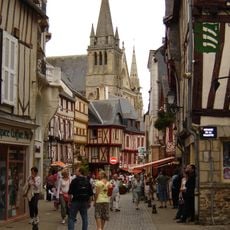
The Musée de la Cohue occupies a building whose oldest part dates from the 13th century, enlarged in the 14th and 17th centuries, facing Vannes cathedral. Its facade has a sandstone ground floor with three large dark-blue-framed windows and an arched doorway carved with the letters "MUSE", topped by cream plaster and brown half-timbering under a dark slate roof with dormer windows. Inside, a central passage links exhibition rooms on two levels.
The oldest part of La Cohue dates from the 13th century, and the building was enlarged in the 14th and 17th centuries. Its ground floor held the market and shops, while the upper floor housed the ducal court of justice until 1796; from 1675 the exiled Parliament of Brittany sat there. The building hosted the Estates of Brittany ten times between 1431 and 1703. The town acquired it in 1813 and turned it into a theatre, active until the 1950s; restored from 1970, it opened as the municipal art museum in 1982.
The museum displays works by local and contemporary artists that engage with the medieval architecture around them. Visitors can observe how modern installations interact with the historic stone passages and spaces.
The entrance is centrally located in Vannes and easily accessible on foot from the town center. The two levels are connected by stairs, so exploring the medieval rooms requires some mobility to navigate comfortably.
The building's name comes from the Breton coc'hui, meaning market hall, a word used across medieval western France. The ground floor held the market and its stalls, while the upper floor housed the ducal court of justice until 1796. The Breton Estates met here ten times between 1431 and 1703.
The community of curious travelers
AroundUs brings together thousands of curated places, local tips, and hidden gems, enriched daily by 92,894 contributors worldwide.