Vannes et sa femme, polychrome granite sign in Vannes, France
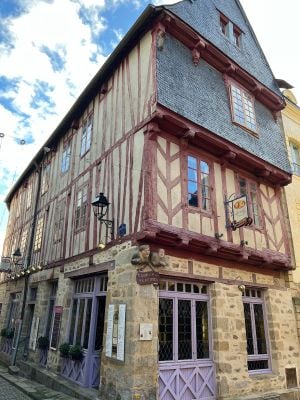
Vannes et sa femme is a painted granite sign made of two busts, a woman on the left and a man on the right, set at the corner of a half-timbered house at 3, rue du Bienheureux Pierre-René Rogue, at the junction with rue Noé. The figures, a few tens of centimetres high, have jovial faces and amputated hands that may once have held an object.
The nickname of the sign was already recorded in the early 19th century, though its origin remains unexplained. The half-timbered house it adorns, dating from the 15th and 16th centuries, was listed as a Monument Historique in 1929. In spring 2010, a piece of the man's head broke off and the upper skull was cut away and replaced by the Bâtiments de France.
The nickname "Vannes and his wife" was already recorded in the early 19th century, though the sign's origin and meaning remain unexplained. One hypothesis links it to a commercial sign, possibly for a tavern; another connects it to the nearby Château-Gaillard or to a local family named Vennes. Similar carved couples exist at Landévant, Questembert, Malestroit, Limerzel and Pontivy.
The sculpture sits at the southwest corner of Valencia square where Rue Bienheureux-Pierre-René-Rogue meets Rue Noé. From this corner location, you can view and photograph the work from all angles.
The sculpture's meaning is unknown: it may have been a shop sign, possibly for a cabaret, or linked to the nearby Château-Gaillard or to a local family named Vennes. Similar carved couples exist at Landévant, Questembert, Malestroit, Limerzel and Pontivy.
The community of curious travelers
AroundUs brings together thousands of curated places, local tips, and hidden gems, enriched daily by 92,841 contributors worldwide.