Castle Site of Montbazon, Medieval keep in Montbazon, France
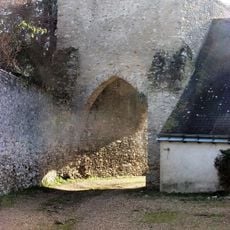
The Castle Site of Montbazon is a fortified complex on a promontory above the Indre valley, centred on a keep still 28 metres high. The keep is built of rough light-coloured masonry, with a flat-faced main tower and a lower crenellated wall to its right, pierced by narrow openings and an arched window recess. Green shrubs line the base.
The castle complex began at the end of the 10th or start of the 11th century with a keep generally attributed to Fulk Nerra, built at the tip of a rocky promontory above the Indre valley during the rivalry between the counts of Anjou and Blois. The tower was raised shortly afterwards, then an outwork, a curtain wall and two enclosures were added up to the 15th century. A Renaissance castle followed, later destroyed when uninhabited and dilapidated.
The site's name comes from Mons Bazonis, and the keep was attributed to Julius Caesar in a 16th-century aveu, since large ancient constructions were then credited to the Romans. Louis Bousrez published one of the first studies of the tower in 1895 in the Bulletin de la Société archéologique de Touraine.
The keep stands 28 m high at the edge of a rocky promontory above the Indre valley; the site has been open to the public since 2003. Parts of the hillside are collapsing, so stay on marked paths and away from the promontory rim. The ground is uneven and the top is exposed to wind.
The keep's present outline owes much to restorations by William Perry Dudley between 1922 and the late 1950s, and by the Atterton couple in the 2000s. These campaigns erased part of the medieval masonry, which is why archaeologists cannot date the tower's phases precisely.
The community of curious travelers
AroundUs brings together thousands of curated places, local tips, and hidden gems, enriched daily by 94,228 contributors worldwide.