Château de Montignac, Ruined castle keep in Montignac-Charente, France.
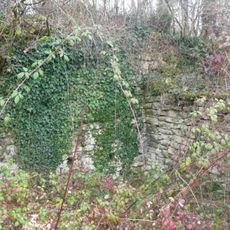
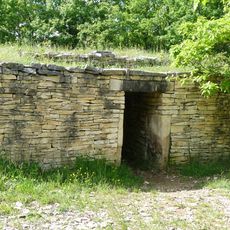
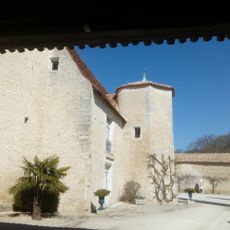
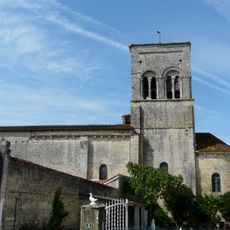
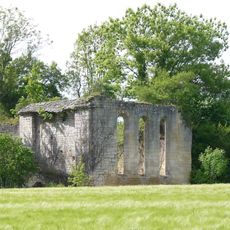
The Château de Montignac survives as a square keep built in 1140, its pale masonry rising above the Charente. The ruined enceinte retains its gate with a portcullis and two round 13th-century towers on the escarpment, plus a round tower and the western wall. The keep's flat top steps down on one side, with two flagpoles on the roofline.
A fortified camp existed here in the 9th century during the Norman invasions. William II of Angoulême obtained the fief and the right to build a castle from the bishop of Angoulême, using stones from the Andone castrum; Vulgrain II built the square keep and enclosure in 1140, and the round towers date to the 13th century. The La Rochefoucauld family bought the castle on 13 January 1399 and kept it until the Revolution; the remains were dismantled around 1840.
The castle gave its name to the barony raised in the 15th century and held by the La Rochefoucauld family until the Revolution. In the late 17th century those lords allowed residents to lean their houses against the rampart walls, and the present fairground occupies what was the lower courtyard.
The site is owned by the commune of Montignac-Charente and is not gated; the keep, the western stretch of the enceinte and a round tower stand on a terrace above the Charente. The ground is gravel and uneven, with low plants at the foot of the walls. The present fairground occupies the former lower courtyard, so the ruins can be reached on foot from the village centre.
The keep stands on a terrace above the Charente, and beneath it a constructed underground passage runs. The castle occupies the crossroads of two Roman roads: the Via Agrippa from Saintes to Lyon, where it crosses the river, and the Via Chaussada from Périgueux to Poitiers.
The community of curious travelers
AroundUs brings together thousands of curated places, local tips, and hidden gems, enriched daily by 93,894 contributors worldwide.