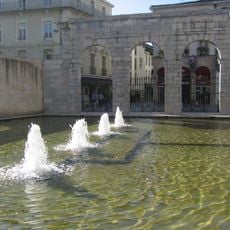
Enceinte gallo-romaine de Dax, Ancient Roman walls in Dax, France.
The Enceinte gallo-romaine de Dax is an ancient fortification wall from the late Roman period that once encircled the city. The surviving sections consist of stonework and still show the guard towers and wall segments of the original structure.
The fortification was built between 350 and 375 CE as a defensive structure for the city during the late Roman period. Archaeological finds such as inscriptions and coins confirm this building phase and show the importance of Dax as a fortified Roman settlement.
The walls show how Romans protected and organized their cities in this region. You can still see today how the stones were carefully stacked to endure over time.
The two surviving stretches stand on Place des Salines and in the Parc Théodore Denis, both in the city centre on the left bank of the Adour, reachable on foot. The northern stretch runs about fifteen metres from the river. The wall face is best read in low, raking daylight, when the courses of small limestone blocks and terracotta bands stand out.
In the north-east sector, where damp was a concern, builders laid a bed of fascines — bundles of brushwood — at the bottom of the foundation trench before covering it with stone. The curtain wall and towers also use opus mixtum, alternating five to seven courses of small limestone rubble with three bands of terracotta.
The community of curious travelers
AroundUs brings together thousands of curated places, local tips, and hidden gems, enriched daily by 92,880 contributors worldwide.