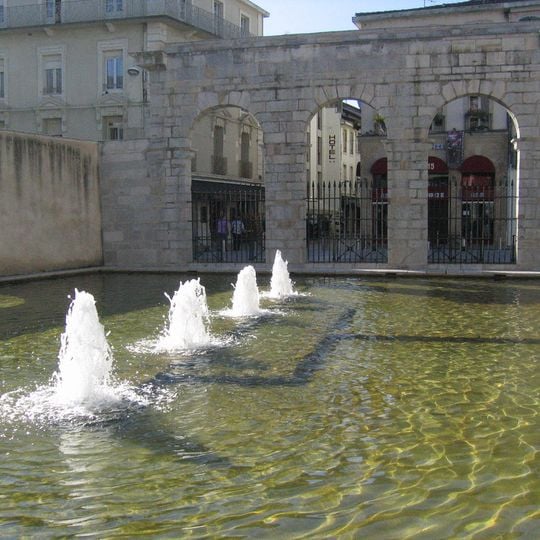
Fontaine chaude, Hot spring fountain in central Dax, France
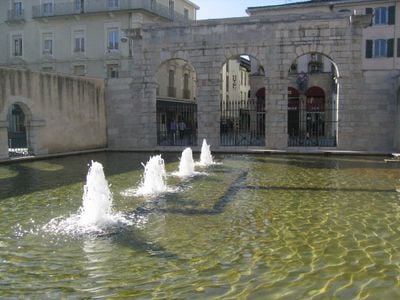
Fontaine chaude is a neoclassical fountain in Dax that releases 2.4 million liters of mineral water daily at a constant 64 degrees Celsius (147 degrees Fahrenheit). The water flows through lion-head spouts and serves as the central water source for the town's thermal facilities.
The fountain was built between 1814 and 1818 during the reign of Louis XVIII. It stands on the site of ancient Roman thermal baths that were originally used for cooking and healing purposes.
The fountain carries the name of Nèhe (or Néhalénia), a Celtic goddess of living waters. Its water, rich in trace elements, has been credited since Antiquity with benefits for rheumatology, phlebology and gynaecology, and it gave rise to Dax's thermal establishments. On sunny days algae appear in the water, similar to those used with Adour silt to make the natural medicine called Péloïde de Dax.
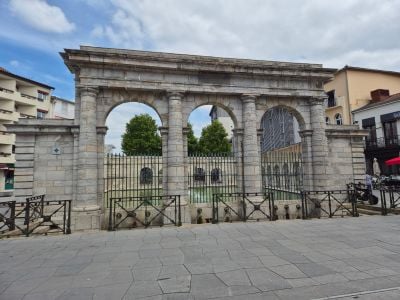
The fountain stands in the centre of Dax, on the site of the old Roman baths, and the portico and medieval remains around it are registered monuments. The structure is open to view from the surrounding square, and the water emerges at about 60 °C, so keep a distance from the jets and the grilles. Look for the small roaring lions on the taps around the basin.
The algae that appear in sunny weather, together with silt from the Adour and the thermal water, make up the "Péloïde de Dax", a natural medicine. The source rises from a fault formed when the Pyrenees were uplifted; rainwater seeps in on the eastern edge of the Aquitaine Basin, warms and picks up minerals on its way down. The Nèhe has the highest temperature, mineralisation (1 g/litre) and flow of the Dax springs.
The community of curious travelers
AroundUs brings together thousands of curated places, local tips, and hidden gems, enriched daily by 92,915 contributors worldwide.