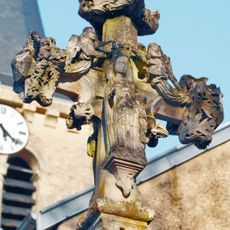
Forges de Buffon, 18th century industrial complex in Buffon, France
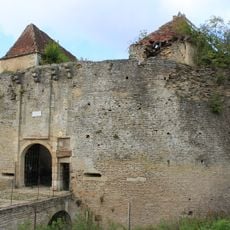
The Forges de Buffon is an 18th century industrial complex that spreads across two levels along the Armançon River. The upper level contains residential buildings, while the lower level houses workshops powered by the river's water force.
Buffon developed the forge between 1768 and 1772 on land and a forge he inherited from his mother, Anne-Christine Marlin, after experiments at his Montbard laboratory, the Petit Fontenet. His heirs sold it in 1791, three years after his death. An exceptional flood in 1866 ended ironworking, and a cement works ran on the site until a fire stopped all industrial activity in 1923.
The forge's name honours Georges-Louis Leclerc de Buffon, who founded it in 1768 and used it as a laboratory, testing cannon barrels for the Navy and the cooling of iron spheres. Around the 100 by 50 metre courtyard stood a bakery, a kitchen garden, a chapel, an orangery and a dovecote for the workers. The two monumental gates were forged on site in 1768.
The site is generally open for visitors to explore the workshops and residential areas at their own pace. Wear sturdy shoes since the terrain is uneven and spread across multiple levels with varying ground conditions.
The two monumental gates at the courtyard entrance were forged on site in 1768 and rest on large dressed-stone pillars. A grand staircase led distinguished guests to watch molten metal being poured from the blast furnace. Every twelve hours, a one-tonne cast could be run into a sand mould after the furnace base was opened with a ringard.
The community of curious travelers
AroundUs brings together thousands of curated places, local tips, and hidden gems, enriched daily by 94,244 contributors worldwide.