Fort Kronprinz, Military fortification in Niederhausbergen, France
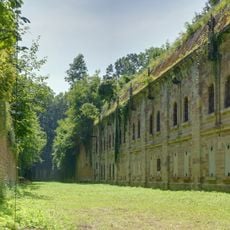
Fort Kronprinz is a long, low artillery fort of the Biehler type, built of rectangular sandstone blocks in tan, pinkish-brown and grey, with lighter stone quoins and window surrounds. Its facade has a row of small dark openings at the base, tall arched windows at regular intervals above, and a few small square windows near the left end. The flat top edge runs straight along the length of the structure, with a sloping bank above and behind it.
Fort Kronprinz was one of 14 artillery forts built in Alsace on the orders of Prussian general Helmuth Karl Bernhard von Moltke after Strasbourg fell in 1870. It followed Hans Alexis von Biehler's detached-fort concept: forts spaced a cannon's range apart around the city, of a planned 36 only 14 were built. Smokeless powder made the type obsolete by 1885, and the fort was later kept as a military depot.
The Orthodox Chapel Saint-Sava inside holds wall paintings created by Yugoslav prisoners during World War II that depict medieval Serbian monasteries. These images reflect the spiritual life and memories that prisoners maintained while held at the site.
The site now houses a primatology research unit of the University of Strasbourg conducting studies on primate behavior and development. Access to the grounds may require advance arrangements, as portions are dedicated to active research operations.
An ammunition explosion in 1953 caused significant damage to the structure and resulted in six deaths, leading to a memorial installation at the site. This incident left visible marks on the fortification and serves as a reminder of the facility's complex post-war history.
The community of curious travelers
AroundUs brings together thousands of curated places, local tips, and hidden gems, enriched daily by 92,892 contributors worldwide.