Fort Liédot, Military fort on Île-d'Aix, France
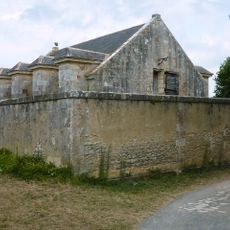
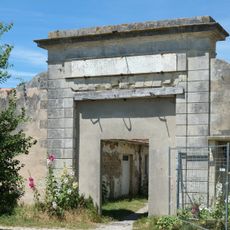
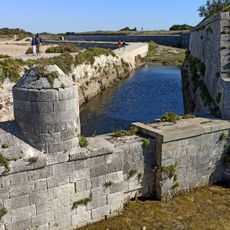
Fort Liédot is a square fortification on Île-d'Aix with bastions positioned at each corner and built partially underground. The structure displays the characteristic geometric design of French military architecture from the 1800s.
Napoleon I visited Île-d'Aix on 5 August 1808 and ordered a fort on its highest ground, sketching the first outlines himself; the site was first called fort de la Sommité. Construction began in 1810 under engineer Thuillier and lasted 24 years, using stone carried by the Charente from the Crazannes quarries. In 1812 it was renamed for Colonel Liédot, killed in the Russian campaign, and was completed in 1834.
The fort is named after Colonel Liédot, who died during the Russian campaign of 1812. It later held political prisoners: Communards after 1871, and from March 1959 to May 1961 Ahmed Ben Bella and four FLN companions, guarded by about 150 gendarmes while the island's coasts were watched day and night.
The fort stands at the highest point of the north-east of Île d'Aix, about 9 m above sea level, and is partly sunk into the ground. It can be reached on foot or by bike, and is open for self-guided or guided visits. The grassy ramparts and courtyard are uneven underfoot.
The planned tower-modèle no 1 became a redoute-modèle no 1 when the fort was finished in 1834, and the source states it is the only surviving example of this type. Stone for the walls was floated down the Charente from the Crazannes quarries near Saint-Savinien.
The community of curious travelers
AroundUs brings together thousands of curated places, local tips, and hidden gems, enriched daily by 94,012 contributors worldwide.