Forteresse de Mornas, Medieval fortress in Mornas, France
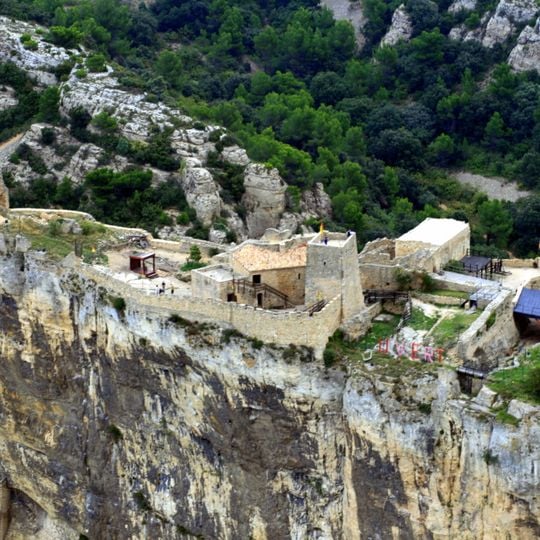
Forteresse de Mornas sits on a limestone cliff about 150 meters above the Rhône and spreads across a large area with multiple building rows. The complex features a strong central keep, various living quarters, and fortification walls that take advantage of the natural slope of the rock.
Mornas is first mentioned in the 9th century as Rupea Morenata, and a medieval castrum is documented in 1088, continuing the ancient oppidum. In 1209, during the Albigensian Crusade, Count Raymond VI of Toulouse was forced to cede Mornas to the Church; the 1229 Treaty of Paris placed it under papal authority. The fortress was rebuilt in the 12th century, saw major works in the 14th and 16th centuries, and was taken by Protestant troops under Montbrun in 1562.
The name Mornas first appears in the 9th century as Rupea Morenata, a rock held by the abbey of Aniane, then the archbishops of Arles and the counts of Toulouse. Since 1977 the Amis de Mornas association has restored the ruins, and summer brings re-enactments and events on the esplanade.
The climb to the fortress goes up from the village of Mornas at its foot, and the ground on the rock plateau is uneven, so sturdy shoes help. The site is a key to the Rhône Valley and a natural observation point over the river; the keep top, 20 m high, gives the widest view. Guided events and reconstructions are held in summer.
The keep is a quadrangular tower 20 metres high, measuring 3.50 by 5.60 metres at its base, probably built in the 13th century. Its flat top is the highest point of the north part of the fortress, above the esplanade bordered by the restored former living quarters and the cisterns.
The community of curious travelers
AroundUs brings together thousands of curated places, local tips, and hidden gems, enriched daily by 93,847 contributors worldwide.