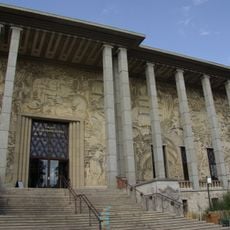
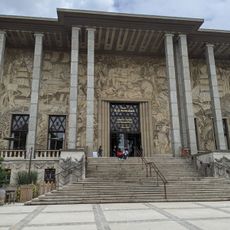
Façade of the Palais de la Porte Dorée, A bas-relief in the 12th arrondissement of Paris
The façade of the Palais de la Porte Dorée is a monumental stone front featuring an enormous bas-relief covering its entire surface. The relief shows thousands of figures, animals, and scenes from different world regions, from African landscapes to Asian areas and ports, along with mythological depictions, all arranged symmetrically on a flat background without perspective depth.
The relief was created between 1929 and 1931 by artist Alfred Janniot to accompany the 1931 Colonial Exhibition in Paris, a major event celebrating France's overseas territories. The creation was a technical achievement that Janniot and about 30 workers realized over two years using plaster casting and stone-cutting techniques.
The name refers to the golden door that once graced the entrance, speaking of colonial wealth. Today visitors can see how artists depicted people from various world regions on the façade, showing their clothing, hairstyles, and tools to tell a story of diversity and prosperity.
The façade is easily visible from the street and offers the best view from the plaza in front of the building, where you can take in the entire composition. The location is well served by public transport and sits in the 12th district, so visitors should allow comfortable time to examine all the relief details at leisure.
The relief is considered one of the world's largest bas-reliefs, covering around 1130 square meters and made from stone sourced in Poitou. Janniot worked with live models and created clay and plaster models before stone blocks were cut, ensuring the larger-than-life figures were clearly visible from street level.
The community of curious travelers
AroundUs brings together thousands of curated places, local tips, and hidden gems, enriched daily by 60,000 contributors worldwide.